
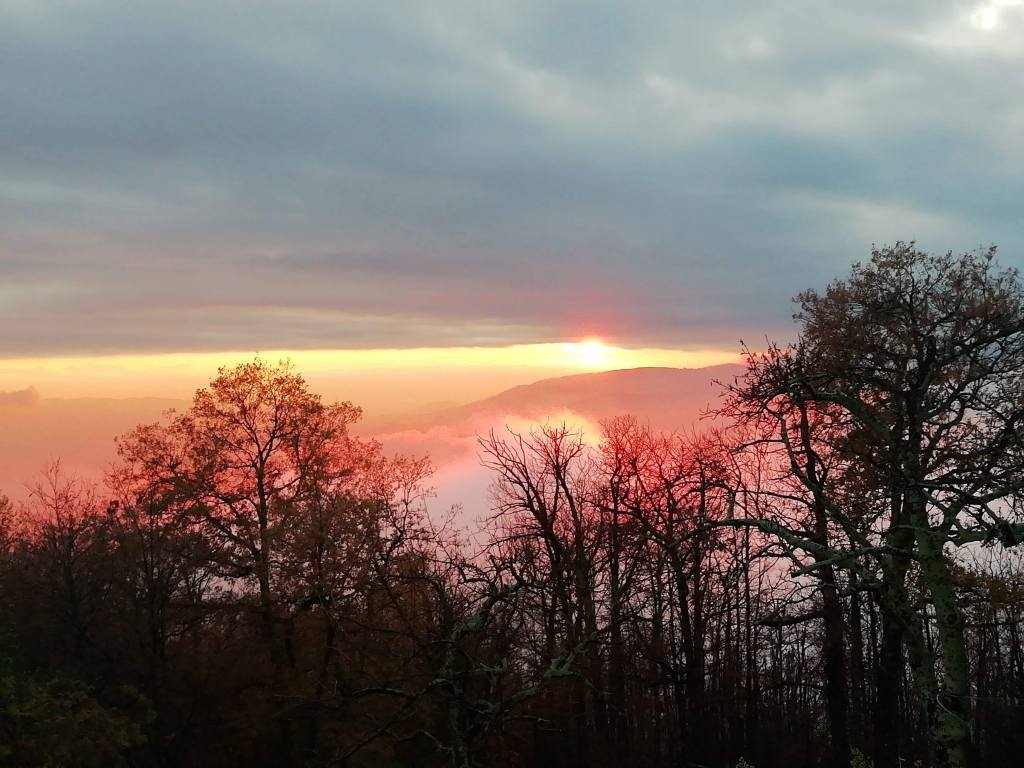
Our winter has been overly warm and very wet. Every day, we take our dog for a walk up into the mountains, along paths we’ve been clearing in order to create a system of trails. On clear days, we prune our trees and prepare garden beds for planting. The wild plums are blooming and so is the camelia, a month early. I feel blessed to live in these mountains especially these days, with the coronavirus epidemic hitting Italy. But even though our isolated position gives us a relative sense of ease, I worry about those who are more vulnerable like our elderly mothers, our kids who live in big cities, friends with fragile health.
We check the news about three times a day, keeping track of the spread of COVID-19, especially here in Italy. Every day brings new regulations, bans, lock-downs, higher numbers of those infected, of deaths, an ever-widening area of contagion. The government has been trying to stay on top of things but the epidemic is constantly evolving and mistakes have been made. The latest was the rather long lapse between news of the impending lock-down of the northern provinces and the actual lock-down allowing many to flee south, many perhaps carrying the virus with them. For the most part, the public who at first reacted with anxiety have been lulled into apathy towards a virus whose death toll seems no greater than the winter flu. Yes, schools, universities, cinemas, theatres, galleries, sports arenas, gyms, discos have been closed, but people still crowd into trams on ski slopes and get together with friends over dinner. But while there are those who find it difficult to renounce the pleasures of skiing, dancing, hanging out with friends, others send out videos over social media urging their compatriots to stay home, to follow sanitary instructions and in general to take responsibility for not inadvertently spreading the virus.
I find myself caught between the alarmists and the gainsayers, wavering between fear of contagion and confidence in my survival, between the horror of rising numbers and the reassurance that those numbers are not in the vicinity. About two weeks ago, shortly after the first outbreak, a message went around on social media saying that recent rentals had to be registered with the local authorities. This was due to a number of Chinese who were seeking out empty houses to rent in the mountains in our area and people were worried that they might be carrying the virus. As the nearby city of Prato (known since medieval times for its textile industry) has the second largest Chinese population in Italy, I immediately jumped to the conclusion that there must be an outbreak there, that the Chinese were perhaps trying to get it under control and that the media would soon pick up on it. The days that followed brought no answers to my curiosity. Why was this large Chinese community with frequent travel to and from China registering no cases of the virus? How was this possible? Were they keeping it quiet for fear of anti-immigrant repercussions? Would we soon find out that we were practically next door to another virus epicenter, a city I passed through on the train every week?
Then yesterday my husband came across an article about this same Prato ‘Chinatown’ and how they have so far been able to avoid contracting and spreading COVID-19. As I’d suspected, many of them went back to China to celebrate their new year with family. Most went home to the province of Zhejiang where, although there have been only 1205 registered cases, people were asked to quarantine for 2 weeks. Upon returning to Italy, the Chinese underwent a voluntary second quarantine. In fact, whole apartment blocks went into self-isolation with families in separate apartments communicating via WeChat and one person in the block volunteering each week to do the shopping for everyone. Furthermore, they adopted habits to inhibit the spread. Instead of touching with hands, they’d use their feet. When returning from outside, a person takes off shoes and over-clothes before entering the apartment, and everyone washes his hands often. As I write this, Prato has only three registered cases of infection, all who contracted it in Lombardia not China.
In Tuscany, all events, gatherings, and demonstrations are now prohibited. Restaurants and libraries operate under reduced hours and customers must be spaced at least a metre apart. The hope is to slow down the spread so that hospitals won’t be overwhelmed. All non-urgent hospital visits and surgery have been postponed to free up medical staff to handle the burgeoning number of COVID-19 patients. How long will it be before the whole of this country is in lock-down? Surely some of those skiers who crowded together at Abetone this weekend and some who fled the red zones before lock-down will infect others who will infect others all before anyone is even conscious of having the virus. Compared to the ‘draconian’ Chinese response, the Italian one sometimes seems slow and haphazard. The give-and-take of different kinds of regimes and their strategies, of cultures and their views of freedom is highlighted in COVID-19’s game of chance.
And yet, and yet, fewer people are travelling and hundreds of flights are being cancelled. Less travel will mean less carbon. For now, Mother Earth breathes a bit deeper and waits, hoping that we humans will come to our senses and realise that the way in which we are destroying our planet far outweighs the gravity of this fleeting pandemic.

 Olivia's Journal
One thought on “Living in the midst”