
On Friday, it took my cousin in Milan an hour and a half to get into the supermarket and friends in Rome said the queues are so long, they’re avoiding them by going to local shops. So this morning I got up really early, downed some breakfast, threw on my winter coat and drove down to Pistoia. On the passenger seat were several self-declaration forms I’d printed out giving my reasons for leaving my house. Having heard about increased enforcement, I expected to be stopped by the police, but the streets were almost empty.
Already a half hour before opening, about 20 people were waiting outside the supermarket in an orderly line leaving the space of two shopping carts between them. Like me, everyone else was a lone shopper; it’s the new regulation. Unlike two weeks ago when the lock-down started, everyone was wearing a mask.
Once inside, I immediately went to the stand with plastic gloves and took two, one for each hand remembering how for years now, I’ve resisted wearing even one when buying fruits and vegetables not wanting to add more plastic waste. I’ve been hearing about the panic buying in US and the UK, but here the supermarket shelves were well-stocked and employees were unpacking even more food items. Still, it hardly seemed like the hustle and chatter of the Italy I know. Hardly anyone spoke as people systematically went about their shopping and even though it was difficult to keep the meter distance, most tried. Priding themselves on eating well, Italians traditionally go shopping at least several times a week; today people were buying more than usual following directives to stock up for at least five days to limit people circulating outside.
Most now want to avoid going into enclosed public spaces anyway; we all know much more about the virus than two weeks ago. In the Veneto, one of the hardest hit regions in Italy so far, the small town of Vo decided to test all its inhabitants, about 3600. What they found was that 6 people turned out to have COVID-19 without showing any symptoms at all. Unsurprisingly, they transmitted the virus to many more people than those who did show symptoms. Furthermore, because their unexplained immunity made them asymptomatic, these “super-spreaders” picked up a much higher viral load over time.
To understand how a viral load works, you must know that a virus is made up of lots of small particles. The greater the concentration of particles the greater the load. If a healthy person picks up just a few of those particles and then has time without any contact to the virus, his/her immune system can cope with overcoming the virus. The greater the load a person is exposed to, however, the harder it is for the immune system to throw off the virus. Even a very healthy person if hit with a high viral load (like doctors and nurses) can succumb to COVID-19. That’s why the fewer people you come into contact with, the more you wash your hands and avoid public places, the lower your chances are of picking up a viral load that will do you in.
Before leaving the supermarket, I went to the restrooms to wash my hands. This is when I realised that there is no way to avoid picking up the virus. Even once I’d opened the door with my elbow, I realised that these invisible germs were probably on the handle of my shopping cart. Sure, they might also be all over the food I’d just bought.
The pharmacy had changed their reception to a foldable white table just outside the door. One person was being served. Signs in the window announced that there were no surgical masks to be had and requested that people keep at least a meter distance between each other. Two pharmacists took turns serving customers, each standing far back from the door to allow the other to come in before exiting to help another person with their requests. Was this the model that all smaller shops would soon be adopting to protect themselves as much as their customers?
Arriving home, I walked into my kitchen before remembering to take off my shoes. It’s not easy to adopt new habits of cleanliness. My mask had gone back into a plastic bag but what should I do with my hat, scarf and gloves? I threw them in the laundry and washed my hands. As I unpacked the groceries, I reminded myself that if we eat most of it after 72 hours, the virus particles will have died off anyway so the viral load shouldn’t be too bad. However, I did follow the advice of an article we read the other day: putting my jeans, socks and shirt into the laundry, I took a shower and washed my hair. After that I made myself a hot cup of tea as hot liquids help to keep virus spores in the mouth and throat from multiplying. Then I went upstairs to wash my mask for the second time in a week.
Well, if you’ve gotten this far, you probably think I suffer from OCD or have gone mad from being in isolation. My response is that desperate times call for desperate measures. Normally, I wash my hands about once a day and certainly wear most articles of clothing more than once. But I remind myself that I am trying to keep from being infected not because I’m afraid of getting the virus and dying (which I consider a slim chance in my case) but because I don’t want to burden the overburdened hospitals by adding myself or anyone else to those who need medical attention, hospital beds and respirators. It comes back to taking individual responsibility for the common good, something that has diminished considerably in recent years.
This is why I’m aghast at the UK government in particular, for stalling. Making suggestions to the public does nothing in these circumstances but create confusion, frustration and defiance. I compare that to Italy. Although the government here should have acted more quickly in order to flatten the curve, at least it has been very clear in its directives and has taken steps to enforce them. Why are other leaders taking so long to follow our example? Why have they flouted the obvious in favour of a vague “hands-off” approach? Do they really care so little for human life?
But I also admit that I’m a tiny bit hopeful. In the last two days in Italy the numbers have showed a slight evening off. And a few days ago, there was a curious article about doctors in Naples who have been finding that some COVID-19 patients are responding favourably to an anti-arthritis drug and scientists in Modena (I think) who seem to confirm this. In any case, my sincere gratitude goes out to all those who are working together to turn this pandemic around, from medics and scientists working on the frontlines to businesses and the self-employed choosing to close for the greater good to hundreds of thousands of children and young people refraining from enjoying the spring sunshine outside. Your perseverance and humility is admirable.
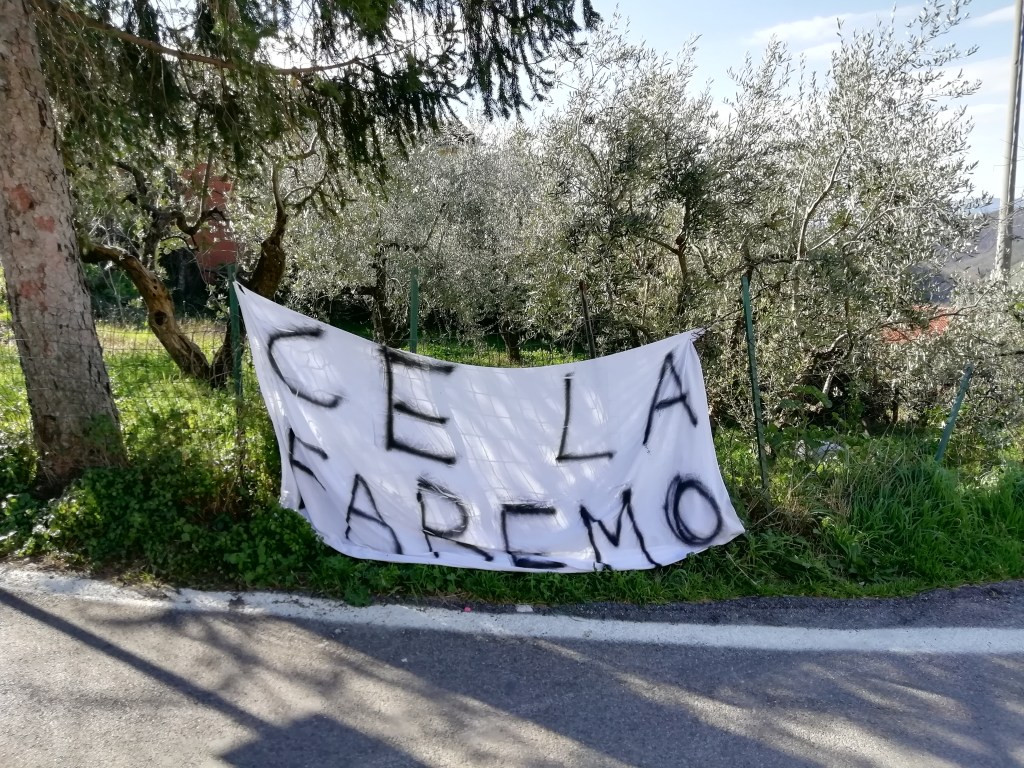
Insieme, ce la faremo!
Together, we’ll make it!

 Olivia's Journal