

A good friend of ours suggested housing a chicken coop and greenhouse under one roof. The greenhouse, which faces south, helps to warm the chicken coop passively during cold months and provides insulation by trapping the heat in the summer. Ours is small because for three hens we only put in two nesting boxes and the covered chicken run outside the coop has plenty of room for the three to stretch their legs, eat and drink. We made sure to make it predator-proof by closing it with wire that we dug into the ground and secured with concrete blocks. The floor is made of concrete tiles too heavy for a burrowing fox or pine-martin to move and the roof keeps off direct sun, rain, and bird predators like hawks and buzzards. During sunny days, when we were home, we planned to let them forage around our property.
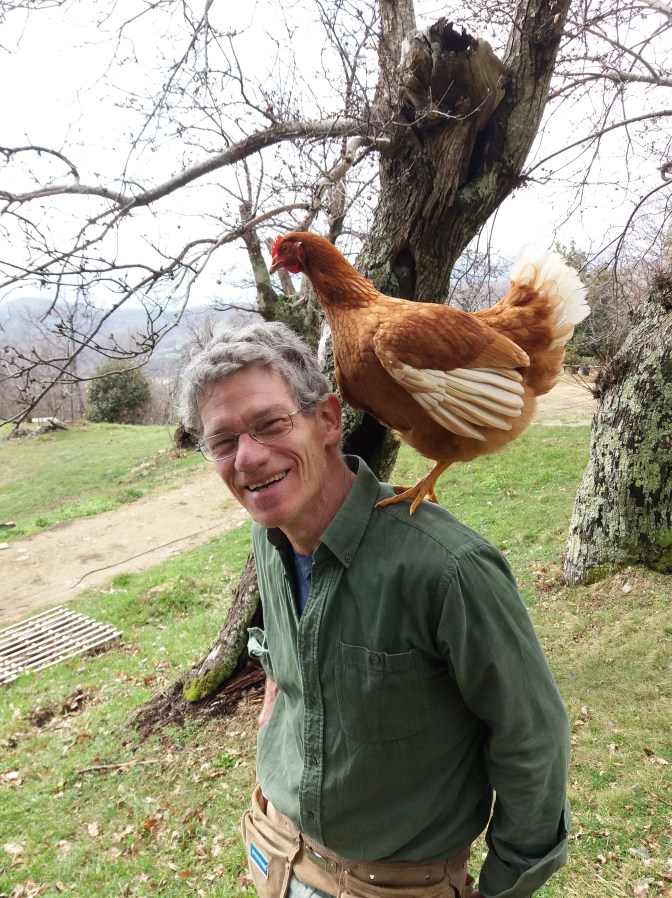
When we lived in Oklahoma, we’d had chickens, but I’d had little to do with them. I imagined them to be pretty much all the same and generally uninteresting. So when we got our three Rhode Island Reds from a local chicken farmer, I was surprised to find that not only did I feel less alone having them around, but also each hen had her own personality. We named them after three sci-fi writers: Doris Lessing, Margaret Atwood, and Ursula Le Guin. Doris was the timid one while Margaret followed Ursula around like a devotee which wasn’t surprising because Ursula was an exceptional chicken. She’d call out to us as soon as she heard the front door open, ‘Hello, guys, I’m over here. Stop by any time.’ We’d often let them out to forage during the day and she’d come find us and cluck quietly at our heels. When we spoke to her, she’d cock her head to listen and when we sat down, she’d fly up and perch on our knee. J soon figured out he could teach her tricks like climbing up to rest on his shoulder. She was an easy favourite.
Last year on a tour of Sicily, we went to a dairy farm to sample local cheese and see how it is made. Some of us wandered into the cow barn where a number of cows were lined up eating. ‘How many cows do you have?’ I asked the farmer. ‘300.’ ‘Do they have different personalities?’ ‘Oh yes,’ he laughed. ‘And I give each a name.’ ‘Really?’ I pointed to the one he was stroking and asked him to name it. ‘Rambo.’ ‘Rambo?! But that’s…’ It was my turn to laugh; the cow had the horns of a bull. Still, I wasn’t too surprised. If my three hens could have distinctive personalities then why not each cow in a herd? I wonder whether zoologists have found individual character traits in insects? Judging from our queen bees, it’s certainly possible.
About ten years ago, a family from South Korea asked me to give their two young daughters English tuition. They were both extremely bright and lovely girls who liked to read and discuss and were eager to understand the British and American cultures which differed in many ways from their own. One day, the older girl asked me, ‘Olivia, how do people here tell each other apart? They all look so much the same.’ I laughed, but she was serious. She thought that, apart from hair colour and body type, Caucasian people’s facial features were confusingly similar. ‘That’s funny,’ I told her. ‘I have the same problem telling Asian people apart.’ ‘Oh, but how is that possible? We are all so very different!’ Now we both laughed.
I guess that as human beings we have a natural instinct to group. We group plants and animals and we group humans. I imagine this goes back to our primitive ancestors whose kinship or tribal group sustained them while outside groups posed threats to their survival. Sometimes, however, grouping limits us and lies at the foundation of injustice and conflict, especially when it is used to paint a large population with the same brush or when we act on assumptions rather than considering the individual situation on its own. Acts of terrorism are fuelled by assumptions about a group of people but so are some individual acts of violence, for example, the countless murders of innocent African American men who are assumed to be criminals.
All Albanians in Italy are thieves. All Republicans love Trump and all Democrats are Trump-bashers. All immigrants get hand-outs and take away jobs that should go to citizens. Spelled out like this, these statements may seem ludicrous because we know that each of these groups is made up of individuals who are exceptions to the rule. But I think we should go further and question the rule. Question our assumptions. Refine our powers of perception so that we notice the small individual differences that make up not only the incredible variety of human beings but of all life on this planet, down to cows and chickens.
Certainly, we are becoming more aware of how animals are treated in factory farms. I think of the difference between the Sicilian or Vermont family dairy farm and some of the huge dairy farms where cows are treated more like milk-machines than individuals. Amongst those who can afford to choose, many have stopped eating veal because of how milk-fed lambs are raised; many buy free-range eggs rather than supporting battery farms; some consume only pasture-raised pork. But the myriad forms of animal abuse for human profit continues.
As an aside, Covid-19 was born out of this kind of environment. It is interesting how the focus and debate has shifted from the fact that the virus can infect anyone and that one’s chances of survival have to do with physical health to the underlying inequalities in economic, geo-political and social systems that affect the mortality rate. Sometimes it’s the system or location that defines the group rather than the other way around.

To return to our chickens, soon after we got our three hens, J made them a chicken tractor. This contraption is basically a chicken pen with wheels. It is open on the bottom so that the chickens can scratch and peck the ground but enclosed on the other sides so that the odd daytime fox taking a stroll can’t just help himself to dinner. It has food and water dispensers and a nesting box so that when we leave for the day, the chickens have a safe place to scratch and peck. The wheels allow it to be moved from one grassy patch to the other, or even one garden patch to the other. The chickens till the ground and leave behind their manure which fertilises it naturally.
There are two ways of getting chickens from the coop to the tractor and back again. One is by herding them which is doable with only three and the other is by enticing. We have taught our chickens to follow us to heaven and back when we have a yogurt container in our hand. Whenever we have scraps that make good chicken treats, we put them in the container – cheese rinds, parsley stems, breadcrumbs, to name a few. Then I tap the container to get their attention (though usually they spot me coming) and they follow me to where I dump the treats, either the coop or the tractor. This was especially important when we saw buzzards circling in the air above and we’d rush our ‘girls’ to a protective enclosure until the danger had passed. It was only months later that we heard from someone in the village that a buzzard can’t pick up a full-grown hen, just chicks.
Unfortunately, only a few months after we got Doris, Margaret and Ursula a dog snuck under our gate. I’d brought the laundry in and was in the kitchen when I saw Ursula fly by the window with a dog close behind. I rushed outside shouting to scare off the dog but too late. In those few seconds, he’d grabbed her and shaken her and dropped her to escape J’s wrath by slipping back under a gate. By the time I reached her side, her eyes were losing colour and her last breath was leaving her still-warm body. Horrified and heartbroken, I wailed.
After a week of mourning and securing the gaps under our gates and along our fence, we went back to the chicken farmer for another Red whom we called Madeleine L’Engle. Maddie, we quickly realised, was not so clever. In fact, she didn’t even know how to scratch so she’d follow Margaret (the new top hen) around and peck wherever Margaret scratched. Furthermore, we worried that maybe something was wrong with her hearing. Whenever, we called the hens, she’d be the one who wouldn’t come. Even the treat bucket didn’t entice her. Most of the time, however, we found her easily because the three hens browsed near each other, although sometimes Doris and Margaret needed a break from each other and foraged on their own at which point Maddie could be anywhere.
One day last Spring shortly after lunch, I went outside with my treat bucket and called to my girls. None came. This happened occasionally if they were having a particularly good time, so I decided to look for them. I found Maddie in the underbrush near the lower gate and led her to the chicken coop. Not spotting the other two in any of the usual places, I gathered they had found a new gap in the fence, perhaps made by a badger or porcupine. The few times this had happened, I’d found them down on the manure pile in our neighbour’s mule enclosure. I gather worms in manure piles are a particular delicacy.
On exiting the lower gate, I checked for gaps, particularly the one between the gate and the post where I’d affixed half a meter of thick plastic pipe, but all seemed secure. Then, a few feet down the path I came across a pile of feathers. A little further along were another few stray feathers then down still more. A fox had gotten in, but how? After carefully checking the perimeter and determining that both chickens had vanished, I went back through the gate. Just inside was another smattering of feathers I’d overlooked. Puzzled, I went back to the gate. The only way a fox could have gotten in was to jump through a 12 cm gap, 50 cm off the ground. And to get back out it would have to have taken the same route, but with a chicken in its mouth. Was that possible? Sure enough, some reddish fox hairs had caught on the top edge of the pipe. This fox had lived up to its reputation.
Poor Maddie didn’t seem herself. She paced the chicken run and ate almost nothing. For two days she laid no eggs. All the advice was to leave her alone and it would pass. We decided two new hens might help. We bought two black hens this time – Charlotte and Emily Bronte. Maddie was furious. Who were these imposters? Right from the start she raged at them and would have defeathered them had we not kept them apart with a screen dividing the chicken run. We decided to give Maddie a good five days to calm down but returning from an errand on the third day, we noticed the screen had been pushed down and the three were sharing the space peacefully. Or that’s what we thought.
It soon became apparent that Maddie was bullying Emily, the smaller of the two newcomers. We kept them apart during the day allowing Emily to stay with her protective sister Charlotte and watched them when they were together in the chickencoop, batting Maddie away when she went after Emily. Then we took to sitting with all three giving them all gentle, positive attention. Slowly, Maddie calmed down and the bullying stopped.
Although we’d always intended to get a dog one day, the fox’s grand theft increased the urgency. Caleb came to us last summer. He is part Labrador (black mama) and part Maremma sheepdog (white papa), but many people around here are sure he is part wolf with his grey and tan colouring. He’s clever and very devoted and we’ve trained him to be gentle with our chickens whom he now regards with variable interest. Someday, I hope to figure out how to teach him to herd them and to keep an eye on them when they are ranging freely, but for now I’m glad he doesn’t try to ‘play rough’ with them.
Lately, Maddie does not seem herself. For the last several months, she has not laid an egg. Her feathers look scrawnier and I wonder at two-and-a-half whether she’s getting old. She’s also taken to bullying Emily again. Perhaps in her egg-less state, she has little patience for Emily’s fearful screeching from her perch before she flies down or her brooding behaviour taking up a nesting box for way longer than it takes to lay an egg. In any case, Maddie doesn’t like her around to the point where she pecks Emily away from food and water.

I consider whether we should give Maddie to a neighbour to make chicken soup and feel little sadness at the prospect of getting to that point. Perhaps after grieving for three chickens, I’ve grown a tougher skin. Perhaps I’ve learned that naming a hen doesn’t make her any more or any less than what she is. Perhaps I am learning to accept that death is part of the cycle of life. Let’s hope that when my time comes, my emotions won’t run around like a chicken with its head cut off but will rest quietly and gracefully as Ursula did in her final moments.

 Olivia's Journal