
I.
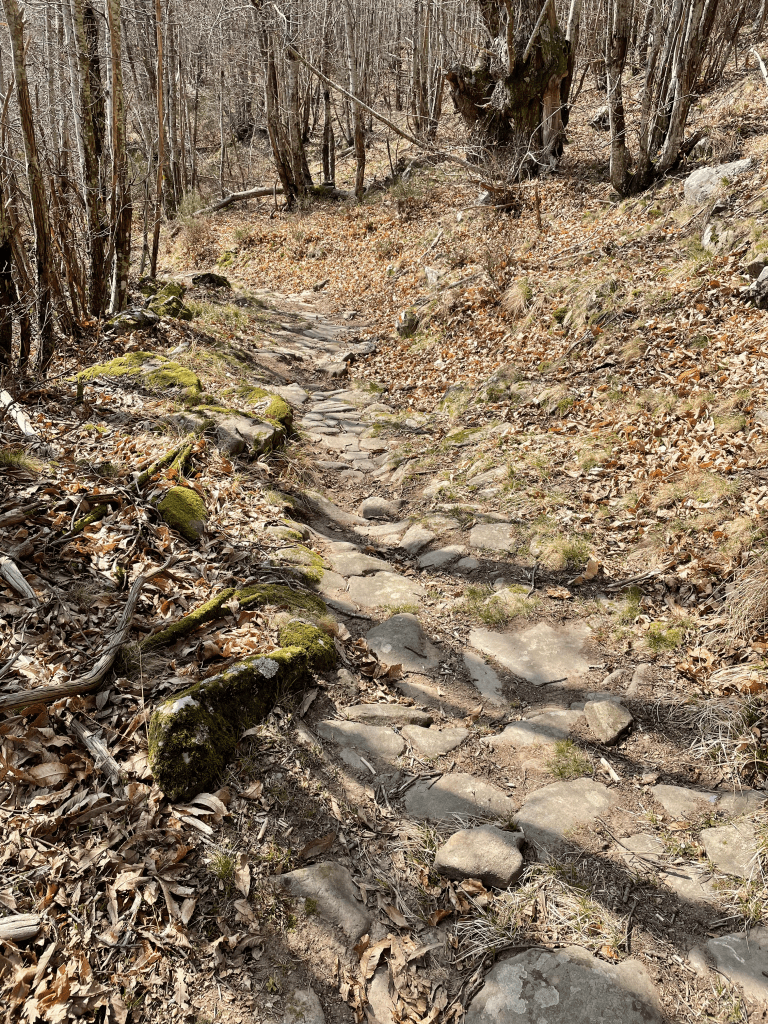
Blessed rain after two months of cold earth turning to dust. I find myself inside with my pieces of writing from the winter, like last season’s leaves I’ve been clearing from the paths. I rake them away in order to make them easier to hike, but then just as I’ve finished a good long section, a herd of motocross roar past, spitting up the earth and leaving behind a wake of loosened rocks and stones that will slip underfoot.
Like the herd of motocross, global crises are spinning across our lives in such quick succession that I find myself breathlessly overwhelmed by the pace. In fact, I don’t know the half of it because for every big story that catches my attention, that rakes across my emotions, that spits more mud across my sense-making, there are countless crises that happen unseen and unheard by most of us. Like the paths up our mountain, I pick up my rake and my clippers to clear the debris and the brambles with determination and perseverance despite the feeling that this need to keep old paths tidy may soon become redundant in the face of overwhelming odds.
Now I flip through my pieces of writing wondering what makes sense in the current situation and realising that by the time I fashion together something cohesive and timely, everything will have changed. Like the winter dust that the spring rain is turning to mud. My mind turns to the war in the Ukraine. Mud and blood. If I were a migratory bird, I might fly there in a day, flying over mountains and snow melting into streams and streams of people fleeing the mud and blood – out, away, gone from their homeland. If I were a bird, what might I see and hear and feel of this world being upended…
I am not a bird and my flights of fancy are just that, although I do believe that imagination is key to what will ultimately save us, if we are to save ourselves and the lives we are upending.
I am not a bird; I am a woman. And how do we define ‘woman’? a recent acquaintance inquired the other day. Not being up on the whole feminist debate these days, the question took me by surprise. It seems like an absurd question and yet there are people who are spending their precious time arguing about whether the definition of a woman is ‘a biological female’ or something more inclusive and nuanced.
And here, with woman and war and winter leaves, I link back to those pieces of writing, reflections post-visit to the US, the first visit in over two years.
II.
Several things struck me on my US visit. First, I realised just how important close family and friends are and how much I had missed them. I relished being in their presence bathed in the warmth of their affection and the comfort of knowing them so well. Second, how refreshing it was to be in a different place with different sounds, smells, and the sheer diversity of people of every colour, persuasion, religion, gender. Whether shopping in unfamiliar supermarkets, walking along unfamiliar streets or paths, striking up a casual conversation with a stranger or eating local food, my dulled senses were stimulated. After the long months of local lockdowns, it felt a bit like a honeymoon.
As time passed, I noticed contrasts to my usual experiences which gave me pause for thought: the number of SUVs on the roads, the increase of suburban sprawl, especially along the Eastern seaboard, the proliferation of shopping centers and malls, how so much more had become so much bigger as if this was so much better. Granted, I saw only a fraction of this huge country, but my impression was that Americans are a long way from downsizing their consumption, and therefore, their carbon footprint. Of course, we mustn’t only rely on individuals to reduce global carbon emissions. Corporations, industries, technologies all must make urgent and concerted efforts to avoid climate Armageddon and therefore destruction of life as we now live it. Still, it’s hard to believe that an alternative is possible without a majority of individuals being consciously and conscientiously committed.
My visit overlapped with the anniversary of what is looking more and more like an attempted coup on January 6th, 2021, and I was glad to hear the mostly female broadcasters interviewing politicians about the “disintegration of democracy.” Finally. Finally, the reputation of so-called democratic systems are being called into question, the systems that use outdated “rules” and updated “targets” to support those in power to behave with impunity. Public trust is eroded: those government changes that make it through the morass of compromises offer nothing truly different. Reputation takes a good while to build up, but it also outlasts its own reality.
One of the noteworthy moments in my travels was a visit to the Jefferson Memorial in Washington DC. It was my son who nudged me and pointed to this quote:
I am not an advocate of frequent changes in laws and constitutions but laws and constitutions must go hand in hand with the progress of the human mind as that becomes more developed and enlightened, as new discoveries are made, new truths discovered and manners and opinions change. With the change of circumstances, institutions must advance also to keep pace with the times. We might as well require a man to wear the coat which fitted him when a boy as a civilised society to remain ever under the regimen of their barbarous ancestors.
Thomas Jefferson
Jefferson spoke these words during America’s boyhood yet how pertinent they are today. Most of the men and women today who walk the hallowed halls of our democratic institutions are still wearing “the coats of boys” in more ways than one. Starting with the suits which they all seem obliged to wear. Why? Suits signal authority, suits request respect, suits show good taste, suits are common to both the ordinary man and the important man – democratic to the core. Suits are as much suited to the game of politics as the tell-tale crowns of king and queen in the game of chess. Both are games invented long ago by white men, games of (like it or not) hierarchy, strategy, control, win or lose, games of sides as white and black as the rules that won’t change even though many of the nuances of our modern-day world are completely different from those our ancestors debated. Ah but there is something so comforting about the clear checks of a black-and-white game.
All this is to say that democratic institutions haven’t changed to keep pace with the subtle and deep shifts in what most now regard as morally right and fair, in how we now define concepts like equality, liberty and truth. In fact, one of the most fundamental shifts has been in gender and racial equality. However, the number of people of colour and of women who have been able to secure a top position of leadership and power do not reflect the shift in attitudes. The statistics on women in high level jobs are sobering: 8.2% of Fortune 500 CEOs; 24.5% of national level politicians but only 8% of global leaders; 76% of K-12 educators but only 24% of superintendents.
I find myself wondering whether this reflects as much a scarcity of women wanting to be in such positions as the ‘old boy network’ making it more difficult for women than men. Stereotypically, ambition and emotion are seen as deficits in female candidates, being associated with callousness and lack of control respectively, whereas those two traits in men are often seen as strengths associated with perseverance and empathy. If there is indeed a gendered response to aiming for high level positions, I would argue that it has more to do with the fact that these positions are dominated by a gender-biased attitude that subtly (and not so subtly) denigrates and undermines a woman’s perspective and way of expression just because she is a woman. As a woman, you either don’t mind the challenge and don the suit, or you do and therefore avoid it.
I pause here to note that discussing gender in binary terms of men and women these days is a false dichotomy. A while ago, I was reading an article about four teenagers who are creating a curriculum that addresses mental health issues. Halfway through I stopped, confused, went back and reread the names of the teenagers. Indeed, the names clearly referred to two boys and two girls, but I was sure that the photograph that accompanied the headline showed three girls. Studying it more carefully, I reflected on my assumptions. Certainly, long hair no longer indicates gender. I finally decided that the one I had taken for a girl with a perky, short haircut, bright eyes and red lips wasn’t. Perhaps the lips were slightly chapped red and the “eye-shadow” was natural making the boy look a little feminine in the photograph or maybe he just likes wearing make-up? Or perhaps considers himself to be “she” or on the gender-bender end of things. What does it matter?
I don’t think it should matter. Although I acknowledge that having different gender categories is helpful to many who don’t feel they fit neatly into being a woman or a man, I wonder whether to some the gender categories are restrictive or even confusing. What if you don’t fit nicely into one of the LGBTQI+ genders? What if you are a boy who wants to be a boy and not trans but to wear makeup, for instance? Wouldn’t it be more helpful – and open-minded – to think of gender as running on a spectrum that includes not only all the gender types but also straddles the “in-between”? The way I see it, gender runs on a spectrum with the very “female” on one end to the very “male” at the other, with each of us actually, psychologically speaking, being our own subtle mixture of the two, no matter what biological sex we are. This is also why I think arguing about the definition of ‘woman’ is both incidental and mundane.
Indeed, gender has always played a central role in the development of societies and cultures. Numerous examples exist of indigenous cultures that acknowledge more than two genders; this is not a new phenomenon. In fact, one could argue that Catholicism has favoured not men, but de facto castrated males called priests, while women with unnaturally unconventional tendencies and ways of seeing and being were persecuted as witches.
In the 1940’s, four women philosophers at Oxford – Elizabeth Anscombe, Philippa Foot, Iris Murdoch and Mary Midgley – questioned the pre-dominant rational, analytical philosophy of, for example, Ayer’s logical positivism. They argued for a more holistic, integrated, applicable approach to philosophy going so far as to honor the roles of emotion, metaphor, art and nature in seeing reality and in finding a more objective truth. Interestingly, Mary Midgley does not believe there is a fundamental gendered divide in philosophy: “I do think very profoundly that we are all male and all female, that these are elements in all of us…”
Iris Murdoch argued that we often base our evaluation of “reality” only on what we see as facts without considering our own biases that come from our attitudes, perceptions, states of mind. And as long as you focus on the freedom of making up your own mind without attending to what is really happening, then you misread situations and miss opportunities to work with others and toward a greater understanding of reality. (Julian Baggini, Midgley on Murdoch, https://archive.philosophersmag.com/midgley-on-murdoch/)
Imagine that we take this view further and apply it to our dominant (and domineering) systems and cultures. I wonder how the world might change if the existing power structures were overhauled and the existing so-called democratic methods were reinvented?
This brings to mind how pruning trees is as much about cutting off the old and diseased branches as it is about encouraging future growth. I turn to another piece of writing left-over from February.
Late winter is the season for pruning. It’s time to remove dead wood, to cut off suckers that will drain nutrients off the main branches, to clip those that will keep light and air from circulating and those that will get in the way of climbing the tree to pick the fruit. It is one of my favourite tasks. The work requires my attention; it requires that I see the tree and imagine its future. Drawn into the tree and out of my self, my mind is calmed. In calming my mind, it can be open to making new connections instead of following the same ruts.
One apple tree has branches that droop down and then curl up. Is this because of the way it’s been pruned or because that’s its nature? Last year many apples fell to the ground a month early and I wonder whether I wasn’t careful enough to check the strength of the branches. Now when I pull down the branches simulating the weight of apples, some snap too easily. My pruning changes and I make sure to leave only strong branches.
III.
Like woman, and pruning, intelligence is much more elusive than its definition. At any given time, all the various strands of thought and action, debate and confusion, facts and feeling form a multi-layered web of which I – or you – only experience an infinitely small part. No one of us will ever really grasp the whole of which each one of us is a part. That is the conundrum and the path we walk together, up the mountain.

 Olivia's Journal