
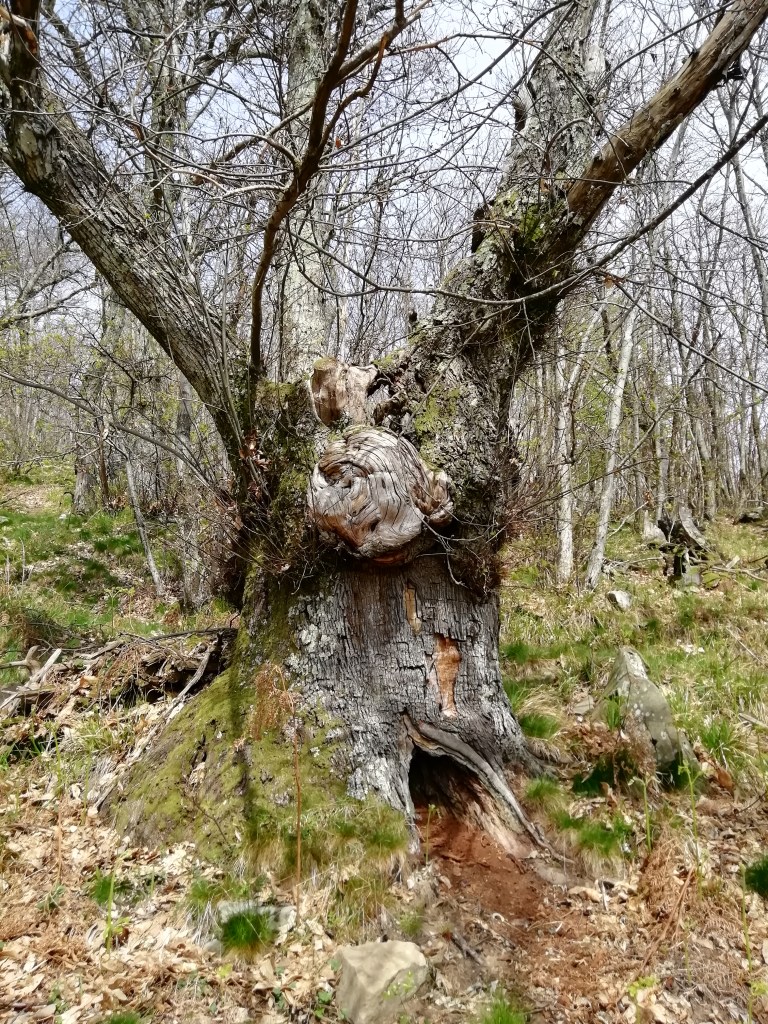
In these early mornings, we hear the call of the hoopoe as it rests here on its migration north. The tell-tale sounds of the cuckoo and woodpecker have returned. Lone wild cherries blossom, explosions of white against the winter brown of the mountain, then here and there the bright green emergence of beech trees. The mountain won’t shake off its winter look though until nearly two weeks later when the abundance of chestnuts will push into leaf.
For the inhabitants of these mountains, chestnut trees were once vital for their survival. The bosco (forest) provided wood for building and fuel while trees in the selvas (groves) were grafted to yield plump chestnuts for food. Around their roots, mushrooms sprang up in the autumn. When my parents bought our house here about 50 years ago, people still tended the woods. In those days men coppiced the trees in the bosco to make into charcoal and the ancient selvas were kept clear as parks so as to easily collect the chestnuts to be dried, husked and milled into flour. Girls and women picked wild berries to make into syrups and liqueurs, several shepherds drove their flocks of sheep up the slopes to mow the open fields, and everyone had his or her secret porcini mushroom patches they harvested in mild, moist weather.
As the years passed, the older generation couldn’t keep up the hard physical work required to maintain the woods and the younger generations had moved to the valley to be closer to work and schools and weren’t interested in spending their free time working on their family’s lands. Nowadays, some people hire woodsmen to coppice their woods; some village families who rely on wood heat do this work themselves. But mostly the bosco is full of snags referred to as secco a piedi (literally translated as trees “dead standing”) and the ancient chestnuts of the selva have limbs that are overgrown and leaves contorted into hard ball-like cocoons containing the larvae of the parasitic chestnut gall wasp. Gnarled tree corpses lie on the forest floor giving up their nutrients to the earth while acacia, oak, ash, hornbeam, and beech find footholds now. Deer have been let out of their confines by the forestry service, wolves have been reintroduced, wild boar, foxes, badger, porcupines and hedgehogs, dormice, voles, squirrels roam freely and songbirds have multiplied since trapping them year-round is no longer allowed. Rewilding is taking place.
Part of me hankers after the tidiness of the park-like selve of old and the woods tended by human hands in apparent harmony with nature. Another part of me loves roaming the wild, unkempt loneliness discovering forgotten paths and overgrown ruins of stone huts, old mills, monasteries. Looking to the future, what should our relationship be with these woods? Should we restore them to their old glory? Should we leave them completely alone? Or can we find a new affinity which will enrich both humans and Nature?
One of the concepts that comes to mind lately is diversity. When I look at the variety of plants around our house, I wonder at the constant change of colours, of insects and birds that are attracted to the plants at different times of day and as the seasons progress. What if only tulips were planted? Right now, they’d be glorious with so many different colours, but they’d soon fade and the pollinators they attract would have to seek sustenance elsewhere. I can’t help but think that this would be true to a certain extent with a mountainside mostly of chestnut groves and woods, not only for animals that have a symbiotic relationship with the chestnut but also for those that don’t, like the gall wasp which first infested the chestnuts here in the Apennines about ten years ago. Fearing we might lose all our trees, we planted beech, oak, maple and mulberry trees on our property to provide future shade in the hot summers. Fortunately, a small ant that eats the wasp larvae has been introduced and seems to be redressing the imbalance.
Still we continue to be reminded of the susceptibility of homogeneous environments. Olive groves all over the Mediterranean are being destroyed by the bacteria Xylella fastidiosa carried by an insect called a spittlebug. Farmers are having to scorch the earth in their groves to inhibit the growth of all the grasses and wildflowers that attract spittlebugs. As a result bees, whose populations are already stressed, are losing an important source of nectar. Hundreds of thousands of olive trees are at risk, however, and so are the livelihoods of thousands of growers who rely on the income from olive oil.
Environmentalists and ecologists have been pointing out for years that monocrops, pollutants, destructive forms of industry (such as logging or oil sands operations) can disrupt the balance of the ecosystem leading eventually to dieback and extinction. Inversely, an area rich in biodiversity can weather temporary environmental upsets more easily. How might we address problems with infestations in a more sustainable way? I wonder whether using the principle of intercropping might help to control this. Intercropping is a simple concept I use in my vegetable garden. By planting my vegetables in small groups interspersed with other kinds of vegetables, herbs and flowers that discourage pests, I hope to avoid a blight devastating my harvest. In addition I practise companion planting: basil adds to the flavour of tomatoes and acts as pest control, cucumbers and beans like each other and cabbages benefit from garlic as a neighbour. Might intercropping be applied to the replanting of olives in hopes of safeguarding them in the future?
The importance of diversity also extends beyond ecosystems. Recent studies have shown that our bodies host microbiomes, environments for tiny organisms. Our health, especially gut health and a strong immune system, depends on the diversity within our microbiomes. So the inside of us needs to be a miniature reflection of the biodiversity outside of us. And while on the subject of mini-diversity, consider the lack of gene diversity in hybrid plant varieties, agro-monocultures and purebred animals that make them more susceptible to certain diseases. We’d considered getting a labrador but decided on a mix-breed with hopes that our dog will turn out to have fewer health problems.
Moving out of the natural world, economic diversification, investment diversification, workplace diversification all are proven to be beneficial because they lower risk of loss and allow for greater flexibility and resilience in times of shock and volatility. Like your great-grandmother used to say: “Don’t put all your eggs in one basket.” The health of an economy depends on the growth of different industrial sectors and a mixture of different sizes of businesses including start-ups and family-run enterprises. Think of the example of a small town in which one large superstore moves in and the small independent businesses along the main street close down. The superstore validates this development (or decline) because it is offering employment, but it is also taking profits out of the community while undermining local independence, custom, and entrepreneurship.
During the time we lived in Oklahoma City, we witnessed a transformation of the downtown area. Local government wanted to attract larger companies to the city. Their research showed that in order to do so, they needed to offer not only good schools but also a vibrant cultural centre with a variety of food, shops and entertainment. It makes sense. Wouldn’t you prefer to live in a city where you can find the kind of entertainment you enjoy be it R&B, country, or jazz, comedy, dance or opera? Although our tastes are so diverse depending on background, culture and personality, it’s something we often take for granted.
Social diversity goes hand-in-hand with cultural diversity and is as varied and complex, if not more so. If you think of yourself as one race from one place, get your DNA tested. It will most certainly explode that myth. We come from all over the world thanks to our ancestors’ need to move from one place to another going back to the dawn of human activity. I’ll even venture that we are strong because we have interbred physically, culturally and socially. And it’s this diversity of human experience and the consideration of diverse perspectives that have, in part, fostered original thought and have led to many of the incredible inventions that have propelled human progress – a topic for another discussion.
You may disagree with all this, but that’s fine. Diversity of opinion is vital to the health of a democratic, pluralistic society. In Hitler’s Germany, any opinion that ran contrary to Nazi propaganda was suppressed and could be punishable by death. When opinions can be openly expressed and debated without fear of reprisal this is a sign of a well-functioning democracy. When not, we should worry.
Returning my attention to this mountainside, I realise that encouraging the growth of diverse species will make this a more resilient ecosystem. This doesn’t necessarily mean leaving it completely alone. Certainly, there is room for non-invasive stewardship of its rewilding. Done sustainably, such as continuing to harvest wood from small plots of woodland at a time or clearing old paths so that people can discover the beauty in biodiversity, this can enrich us without being invasive to the ecosystem. As the seasons shift, merge, change, we will need to find new ways of co-existing with our environment and with each other.
During the current world crisis, I’ve been struck most by the huge contrast between the arrogant, self-serving actions of some national leaders and the humble, generous, brave actions of their most vulnerable citizens. So this is an attempt to re-assess what I am doing in our volatile world and to attribute value to those aspects and actions that will lead towards a healthier, kinder and more balanced future for all life.

 Olivia's Journal
I love the idea of extrapolating from biological diversity to cultural / human diversity. Much better for my sanity to think of Trump as a basil plant, though I think a slug might be as far as my imagination can go!
LikeLiked by 1 person
A wonderful, beautifully written essay that pulls together many aspects of our world. Diversity is the key for flourishing kingdoms of plants, animals, mushrooms,…There is a powerful novel by John Powers, “The Overstory” in which chestnut trees play a part. The lost of the American Chestnut caused an economic and cultural devastation here that is still not fully understood. It changed everything.
LikeLiked by 1 person
Yes, the opening chapter of “The Overstory” (by Richard Powers) resonated with me too, surrounded by these ancient chestnuts, and the novel had me looking at our forests in a whole new way.
LikeLike
Another wise and inspiring piece of writing. When we came to our current house the garden had totally rewilded in its small space in 30years.We were very blessed as the sloe worms , wonderful moths and wild flowers remain. One only hopes that the tending one has done has kept the balance.
We have a friend who came from a village in tuscany -Montelaterone-where many of the older men had died. They would go together to harvest the chestnuts…..and eat a form of chestnut polenta with none of the peppers and olives that were served at home with this. Unf this damaged the lining of their stomachs. A sad reminder that the balance in nature is so subtle. We have to try and recognise this and learn from our mistakes…and try and keep a balance -that in the end is much more productive and long lasting than high productivity.
LikeLiked by 1 person