
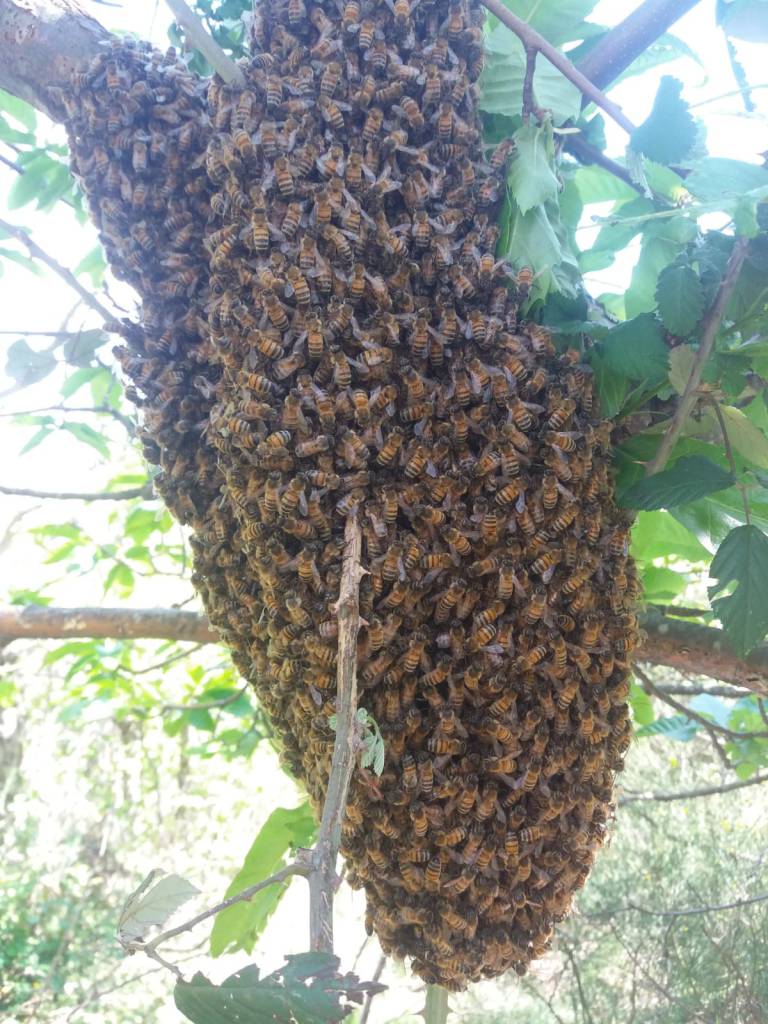
The day before yesterday, I was adding fresh soil to some winter-weary plants when I heard the buzzing of thousands of bees. My first instinct was to search for a flowering tree but our fruit trees have bloomed and our chestnuts won’t do so until June. Instead the air around our beehives was filled with thousands of bees. They were swarming.
I’d been a little worried this might happen because we hadn’t been able to check our hives for queen bee cells. Queen bees are typically produced in the spring, especially if there are a large number of bees in a hive. It takes 16 days for them to develop and hatch. So, if a beekeeper wants a colony to stay full and strong in order to be able to harvest honey – around here the Acacia trees bloom in May – then the queen cells need to be destroyed. On the other hand, if a beekeeper wants to get a new colony of bees, she can either remove the frames with the queen larva (and some of the bees) from the rest of the colony… or leave it be and let the queen hatch in the hive.
Once a new queen hatches either she fights the old queen and one of them dies or, more commonly, one of the queens (usually the new one) leaves the hive taking at least half the bees with her. These bees swarm through the air keeping track of the queen until she lands somewhere like a branch. Then they create a cone of bees around their queen in order to keep her safe while a few hundred scouts fly off to look for a suitable new home. The cone (swarm) of bees becomes silent and in this state, the bees are very docile because their little bellies are full of honey to bring to their new home.
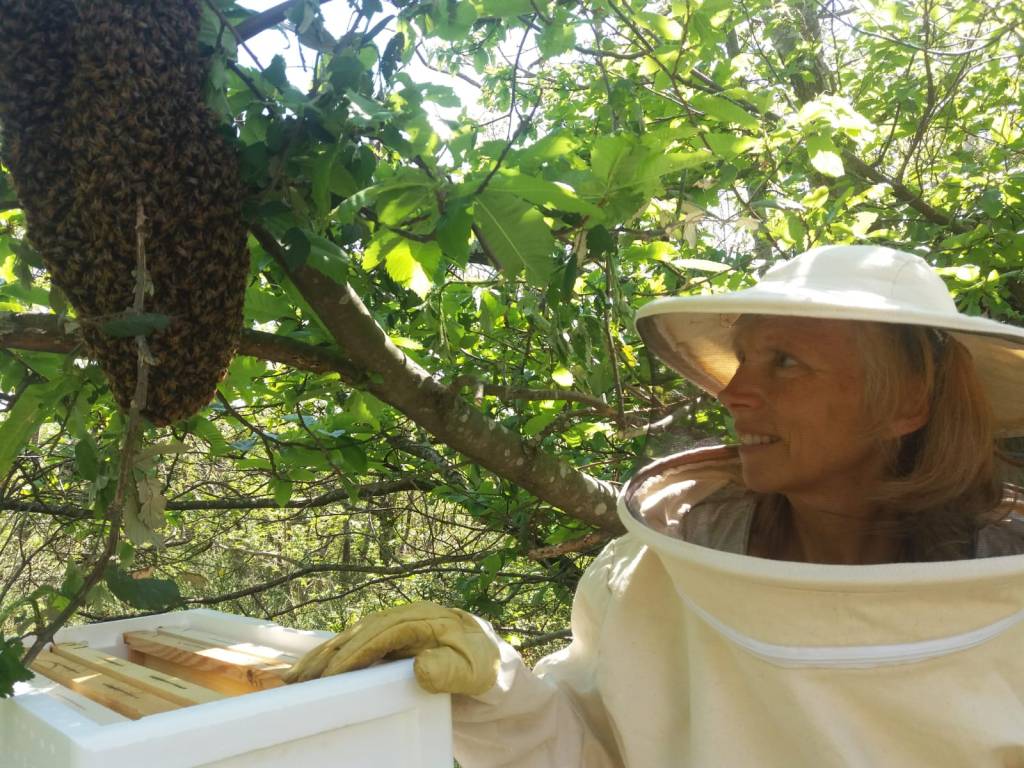
Our swarm ended up hanging from a thick branch over a bramble patch. As this was our first time dealing with a swarm, we called our master beekeeper Virgilio who arrived within a half hour. Wearing masks and keeping our social distance, we followed his advice to cut away the brambles so that we could put a box with frames for their honeycomb under the swarm in hopes that they would adopt it as their home. We could then transfer them to a new hive or to an old hive whose colony hadn’t survived the winter. First, however, we’d have to inspect our three hives, which we refer to by their colours: red, yellow, and green.
What I have found one of the most interesting aspects about beekeeping is getting to know the individual ‘personalities’ of each colony. I’d always assumed that one colony would be much like the other and in certain respects they are. Each one tends to have a section of frames that is devoted to breeding. As each worker bee only lives for 28 days, during the summer, the current generation is constantly busy producing the next. Most frames, therefore, contain brood cells with larvae in various stages of development. Some frames have more honey and these are often in one section of the hive. But the decisions as to how to multiply in the spring, whether efforts are focussed more on pollen collection or on making worker or queen bees, are up to the queen. In fact, the way the bees behave as a collective – aggressive, peaceful, nervous or carefree – has to do with the ‘personality’ of their leader, the queen bee.
From our observations this spring, we were sure that the red hive was the most active, and typically the most aggressive, and would probably have quite a few queen cells. The yellow one was also quite active but the green one seemed possibly to be dying, or dead, as there were very few bees flying in and out of it. Furthermore, of the three hives, the colony had not been feeding much on the bee food we’d given it to help it through the winter compared to the red hive, for instance, which had the most voracious appetite for the stuff. We started by opening up the green hive in case we could clean it out and reuse it as a home for the swarm.
To our surprise, we found that the green colony is trying to be self-sufficient. It is certainly the weakest in terms of numbers but it has a good store of honey and lots of larvae and new bees that are ready to hatch. I will be curious to see how this one develops and I have great respect for the green queen as her worker bees are generally very peaceful. In the red hive, even though the queen cells are large domes that are hard to miss, we couldn’t find 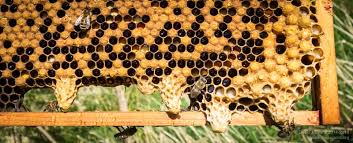
a single one. Here were lots and lots of worker bees and a good number of larvae but not much honey. Different queen, different strategy. The yellow queen is either feeling old or claustrophobic because we found about eight queen cells and dozens of cells with drones which are necessary to mate with the queen. Having already lost half their numbers of worker bees, we didn’t want any more queens dividing the hive further so we levelled the queen cells.
Thankfully beekeeping is considered an essential business so I was able to buy a new hive that afternoon which we promptly put under the swarm. This time I shook the branch quite a few times. Clumps of bees fell into the hive and I hoped this would be sufficient to draw the queen down into it, but by sundown, they’d all gathered back up in their cone. Virgilio told us to leave them for the night but to cut the branch first thing in the morning and lower it into the hive. We went to bed feeling a bit uneasy as the forecast was for rain. Would this make moving them easier or might the wet bees bring too much damp into the new hive?
We were up before sunup pulling on our bee suits, getting out the saw and clippers. As a light rain started to fall, we clipped away all the small stuff, cut the branch and slowly lowered the swarm into the hive. Cold and dozy, they gave us no trouble as we carried the hive to its place near the others. I noticed that in the swarm a bridge of bees had formed from the branch to the nearby frame so we decided to leave them while we had our coffee. But soon the rain picked up and a peak into the hive revealed that nothing had changed. Virgilio advised us to shake the branch and remove it so we could close up the hive. With three hard shakes nearly all the bees dropped into the hive. After putting the lid on, we left the remaining bees on the branch to find their way into their new home. Mission accomplished. Now we have to leave them for a good week before checking on them. If we open the magic box too soon, they’re likely to decide to leave.
So how does a swarm decide where to make their new home? Our son, who studied collective decision-making in animals, told us that contrary to what I’d assumed, it isn’t the queen who decides. It’s the group. The scouts who go in search of a new home instinctively can tell the difference between a great one and a mediocre one. Each scout only visits one site and when it returns to the swarm, it does a waggle dance. The longer and more enthusiastic the dance, the better the accommodation and therefore the more bees will get excited about it. The scout with the greatest number of followers wins. Sort of like elections.
Unfortunately, we did not give our bee scouts much chance for competitive dancing but we did give our swarm a nice cosy hive in which to make a new home. I look forward to getting to know the new queen, her general disposition towards others and her attitude towards the survival of her colony as seen in the decisions she will make. It’s a difficult world these days with mysterious causes of massive bee deaths and new illnesses and parasites appearing practically every year. Beekeeping makes me aware of the amazing intelligence and organisation of these small but important pollinators whose sting we fear and whose honey sweetens our lives. It’s yet another reason we need to work harder to make a greener world in which they can survive.

 Olivia's Journal
This is great Olivia and so informative
LikeLiked by 1 person
Amazing. We followed you every step of the way with bated breath. Well done..my knowledge of beekeeping has increased through reading this beautifully written piece. Hope they now thrive in their new hive, Anitax
Sent from Mail for Windows 10
LikeLiked by 1 person
I echo Anita’s praise. Fascinating and enlightening, Olivia. Thank you. Tom X
LikeLiked by 1 person
Olivia I loved reading this. A few months ago I attended a talk by an agricultural seed developer who knew the value of bees. He had bees and was very knowledgeable about them, the science of them. One of the most interesting facts he told us about bees is that they go on their scouting missions to find the best pollen and are able to communicate to the rest of the bees in which direction and how far this good pollen is. Very clever.
LikeLiked by 1 person
They are amazing little creatures. As they live only 28 days they must be born with the knowledge of how to do their precise waggle dances, or else learn all that at a phenomenal speed. I look forward to learning more about them, at a very moderate speed.
LikeLike
I was riveted to this piece. Absolutely facinating. I had no idea and am not only amazed but enlightened and yearning to read more. Thank you Olivia
P.S. A few more photos would be nice for those of us that are clearly clueless.
LikeLiked by 2 people
Thank you for your suggestion! I’ve added a few more for illustration.
LikeLike
Hi Olivia, Lou and also have a few hives in Brattleboro, and your account of capturing this swarm really touched me. Thanks so much for sharing. Our bees don’t even think of swarming until late June or July. Dunham and Lou
LikeLiked by 2 people
Yes, you are further north than we are. I suppose you gather honey just once a year and that it’s wildflower honey?
LikeLike