
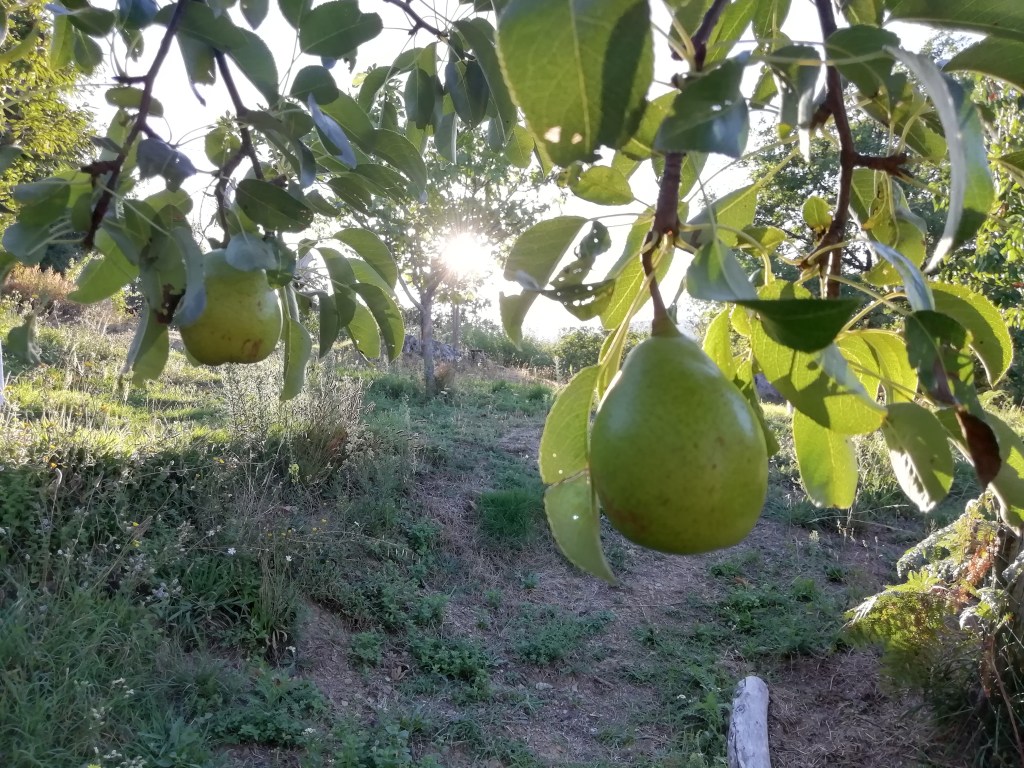
…Summertime is falling down and winter is closing in
I’ll ply the fire with kindling and pull the blankets to my chin
I’ll lock the vagrant winter out and I’ll bolt my wandering in
I’d like to call back summertime and have her stay for just another month or so
But she’s got the urge for going so I guess she’ll have to go
She gets the urge for going when the meadow grass is turning brown
And all her empires are falling down
And winter’s closing in…
Joni Mitchell
This song came on the radio the other day and it spoke to my own mood these days. Usually the cool weather doesn’t arrive for at least another month but this year it has come early. It timed its arrival with the departure of the last of our summer neighbours. We are alone in our hamlet of three houses on the hillside.
The cloudless, bleached days of August are gone. Our woodshed is full and we have built another wood-store for the logs we still need to cut and split. Energised by the early fall breezes, along paths strewn with leaves and bright green chestnut burrs, our walks up the hill with Caleb are getting longer. My garden is winding down its abundance of tomatoes and cucumbers, the pears and grapes are all picked and I’m starting to plant the winter crops. My wildflower meadow has turned brown.
So far, we haven’t heard the geese heading north. The first frost is yet to come. The olive harvest hasn’t begun. We have lit our woodstove for hot water but haven’t turned on the heat. We wear sweaters and socks. In the middle of the day when the sun is up high, we throw our windows open. As soon as the sun passes behind a cloud, we close them again. I haven’t put my summer clothes into store; they hang idle though. And I?
I’m not sad to see summer go. I embrace the golden light, the cooler weather, the warmth of lit stoves. Autumn has always been a favourite season. A self-professed introvert, I don’t fear being alone in our isolated farmhouse. To the contrary, I look forward to spending more time writing and less time keeping up with gardening and guests, with watering and weeding. The wilting heat has gone; it’s time for new growth.
Even the rain is welcome. I have many inside plans: sewing a new pair of masks from scraps of cloth, vacuuming up the accumulation of dog hair (Caleb is shedding again), preserving – the cucumbers in particular. Yet this year, unlike others, I feel a slight unease that leaves me at a loss. It’s not about here; it is about here. It’s about the second wave and about the darker months to come, about my certainty that we humans have an overwhelming struggle ahead and about the uncertainty of any outcome. The uncertainty of hope, a small sailing vessel in the midst of a vast ocean and unpredictable weather.
It’s about here; it’s not about here. I am not alone here even in the splendid isolation of this mountain. I am part of a much larger whole that includes you. Yes, you. You too are part of this same much larger whole. A whole from which we may want to be separate or in which we may want to stand out. Independent. Self-sufficient. Individual. Free. You and I have always felt some power in these words. We have identified with these attributes in a positive way because they are connected with being strong and self-assured. Doing what we want. Isn’t that what Life is about?
The thing is that independence, strength, and freedom do not take place in a void. They take place within a larger context. Our very perception of these attributes hinges on what is happening around us, on our relationship to others: family, friends, social groups, community, nation, world. I use the word ‘perception’ deliberately because media sources distort facts, and social media often narrows our world view even further in order to increase use by its users and thereby, profits (if you haven’t, watch “The Social Dilemma”). In fact, social media takes advantage of our very human need to belong.
Even I, content to be an outsider, am realising that my ability to work peacefully on my own is in direct proportion to my feeling of belonging. Where do I belong? Here. This place is where I belong. I love living on this piece of land, in the house my parents bought as a ruin more than fifty years ago. It’s a place I’ve been returning to and working on for almost my entire life so of all the places in the world, this to me is Home. What makes me feel like I belong? A sense of being held, held by the land… and also by the people and animals around me.
But we miss what we cannot have and I miss my family – my mother, my children and my grandchildren especially – none of whom live nearby. They are also part of my belonging. This on-going pandemic is curtailing my freedom to go visit them and their ability to visit me. It makes me sad to think I may not see them this winter. How must it have been for families even a century ago whose loved ones left to seek new opportunities in far-off places? Saying good-bye not knowing whether you’d even see them again must have been difficult and although the passage of time might dull the longing for their company, it would never erase it completely. Letters and keepsakes and favourite anecdotes kept memories alive and that thread of belonging from breaking.
Now we have virtual relationships. Facebook, WhatsApp and Instagram keep us up-to-date on friends’ activities and perspectives; zoom meetings take the place of family get-togethers and coffee mornings. This is how many of us now feel a sense of belonging. But unfortunately, by depriving us of personal contact, this virtual sense of belonging also undermines our ability to empathise with or even tolerate perspectives that contrast with our own. Our virtual worlds are controlled environments that falsely mirror our real world. WhatsApp messages leave the interpretation up to the receiver. Facebook posts gloss over challenges and proclaim biased views as facts. Even zoom meetings leave little room for unsettled silence, intuited feeling, honest disclosure or discussion.
Not that face-to-face meetings are honest, un-biased, or clear in intent. Actually, without the ability to make hit-and-run statements, face-to-face meetings can be more uncomfortable. But it is this very discomfort that challenges us to try to understand, to empathise, to find common ground. Without this, we lose perspective of what it means to be humane and humble. I really believe that this is one of the reasons we are seeing such an intense polarisation in the world today; why for example someone can feel justified for killing another who simply asks him to wear a mask.
Hatred, hate speech, violence and intolerance of all kinds have always existed. True. I am seeking a way through, around, over or under this festering current that is flooding our societies today. Perhaps naively, I am turning my focus toward my local community. I say naively because visitors to our village often form romantic impressions of our lives here and having worked in the village council, volunteered in village events and developed what I hope are strong friendships, I can see that even in our lovely village, suspicion and pre-conceptions run deep. A remark taken the wrong way can lead to years of rancor. One broken commitment can bring distrust and exclusion. “Olivia, you can’t expect anything from anyone around here,” I am often told. “That’s just the way it is.” “No one cares anymore.” “The village will never change.”
This village is a microcosm of the world and it mirrors so many other communities in countless countries. The mass migration to the cities, the fracturing of extended families, the invention of machines and technology that draw our attention away from our immediate environment have expanded education, income and opportunity but have also contributed to the disruption and degradation of community.
I prefer to look at it as a disruption because the physical community still exists and therefore also the possibility to restore the sense of belonging to the community and all that this belonging entails. Working with the good, bad and the ugly, with the past and the present but with a focus on the future, with dreams and hopes that small is beautiful. Small steps are key; they are the beginning; they are full of possibility. I will start with where I am, where I belong, and allow summertime to move on. She will return.


Lovely words – so well put, so descriptive and you have the ability to catch nuances and ideas which is quite unique.
LikeLike
Thank you, Audrey. It was difficult getting back into writing after the summer so your kind words are especially welcome.
LikeLike
Ay Olivia querida,
So very moving. You touch the soul and spirit. Thank you. I am so glad that Ralph and I had a chance to share time with you both on your mountain side. Memories of J’s risotto and quiet conversation in your cozy kitchen filled with your garden’s harvest still make me smile and reassure that indeed summertime will return. May you and family and friends remain safe and strong and forever kind and curious in these times ahead. And may you continue to share your wonderful words.
LikeLike
Valerie, thank you for such a lovely comment. “Altre tanto,” as they say here in Italy — I wish the same for you. We loved your visit and hope you both are settling well in your new home, staying healthy and keeping your generous, compassionate spirits shining in the midst of this crazy world.
LikeLike
Onward mujer….
Meantime may the US elections give us hope! Everything seems so up in the air.
LikeLike