

We all find different ways to escape the stresses of life. Some do yoga, some meditate, others find alcohol relaxes them, some go for a run, work out, others play music, walk the dog, watch comedy. I prefer to immerse myself in nature.
Too far away to be able to take care of my mother, my children, my grandchildren, too far away to be able to protest and too far away to help get out the vote, too far away, I find solace in bringing my attention to my immediate reality, to what needs to be tended to. Stacking wood, preserving pears, mowing, raking, pruning, taking our dog on solitary walks up the mountain, I am kept aware of my reality in the midst of what mostly seems like a chaotic world these days. In the last few weeks I’ve held the emotional turbulence of the US elections at bay by picking olives.
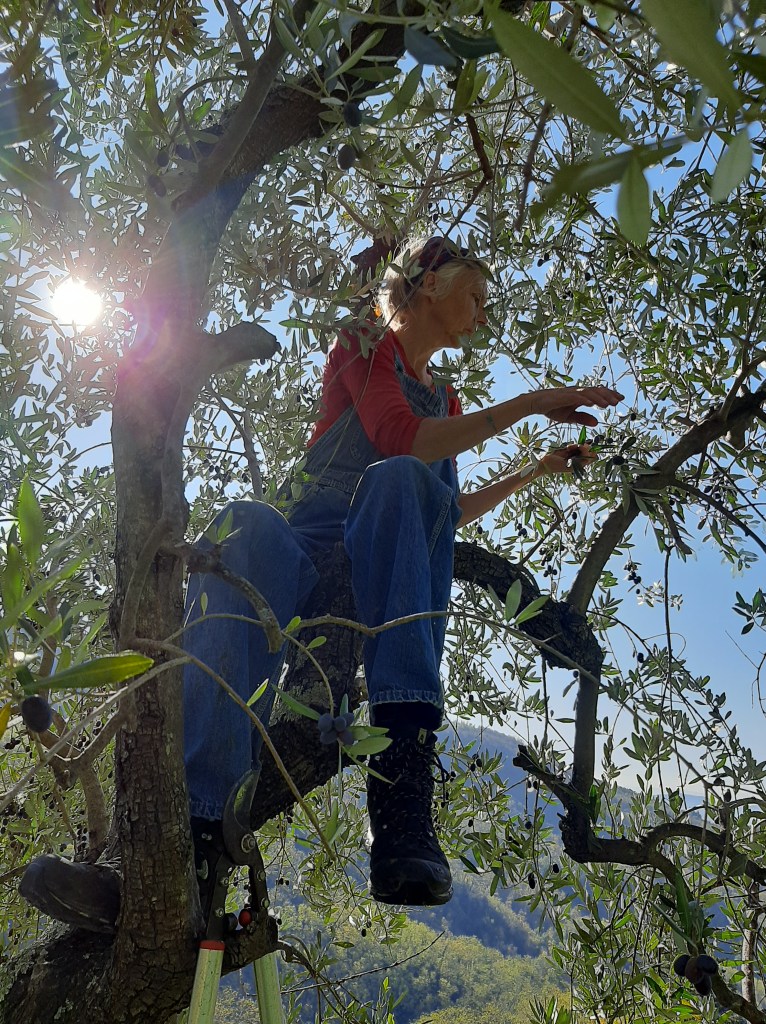
The olive harvest is one of my favourite agricultural activities. For one thing it involves trees easy to climb and I’ve always loved climbing trees. On the army base where I spent much of my childhood, there was a small patch of woods in front of my apartment building. Not many friends were as enthusiastic as I was about climbing trees but those who were, often joined me for a tour of my ‘tree house’ in which each branch was a different room.
Olive trees, however, are notorious for their fickle support and every year, many topple out of them resulting in varying degrees of injury. A few years ago, a good friend, who was pruning his olive grove, fell out of one of the trees and would have been paralysed (or worse) had his son-in-law not been there to get him to the hospital in Florence where the best spinal surgeon operated immediately. Fortunately, he has recovered sufficiently to walk, slowly, with a cane.
Nowadays, most serious olive-pickers avoid climbing into trees by using an extendable electric rake that shakes the olives loose. This time-saving device allows people to work much more quickly, completing a harvest in about a quarter of the time. As we do not have such a marvellous rake, we resort to the age-old tradition of collecting the olives by hand.
Although we do not own any olive groves of our own, there are many around our village that have been abandoned. Some are barely visible under the hills of brambles and vines that have been left to grow unchecked. Faced with this situation, owners who are unable to tend their olives are grateful to have others keep up the land and trees in exchange for the oil. We are tenants of several olive groves belonging to three different people. As such, we keep the undergrowth of grass, brambles and vines cut, maintain or put up fences, prune the trees in spring and pick and press the olives in the autumn. In return we get to keep the oil although most owners are grateful for a token litre or two depending on how productive the season has been.
And productivity does vary. The olive harvest, like any harvest, depends on a number of different conditions including weather and insects. Around here, the olive fruit fly is carried in on a late summer or early autumn breeze. It lays its eggs in the olive and when the larvae hatches, it eats its way out leaving a hole allowing air and humidity to rot the olive. The olive fruit fly completely ignores boundaries which means that some trees are more affected than others even within the same plot. Generally, the smaller and greener the olive, the less likely it is bacato (rotten). We’ve checked our plots and while one or two are not worth harvesting, the others have a number of trees with mostly healthy olives. As last year there were no olives because of several hailstorms in the spring, this year we are eager to harvest.
In part because we are unable to host volunteers this year, we have decided to work with our friend Gianni, combining our plots and splitting the oil 50-50. Like many small-scale fruit harvests, the more the merrier and the more efficient. Therefore, whole families reunite for the olive harvests, neighbours help those who don’t have able family members, and friends lend a hand because it is a social and fun activity. The variety of tasks means that everyone feels useful and no one gets bored, and the ease of picking allows for plenty of conversation.
Early in the morning, we load up our car with the essentials: nets, olive rakes (not electric), clippers and crates. We also pack food and drink for the day so we can take full advantage of daylight hours. The work is simple: we spread large, fine-meshed nets out under the trees we plan to harvest – usually about three or four at a time. While some use fingers and rakes to pull olives off the lower branches, others climb into the trees to harvest the ones that are difficult to reach from the ground.

A number of our plots are steeply terraced which makes the work trickier. Metal rods hold up the edges of the nets on the lower trees to catch the olives rolling downhill (they are, after all, round). Some of our plots are not next to a road and one of them borders a wall which means we have to haul our tools up a ladder to a narrow ledge before untying the gate made from an old frame of bedsprings. This gate was an attempt to keep out the deer which have since eaten their way up through the bramble hedge to get into the grove. The deer have a healthy appetite for the willowy olive branches. Putting up a fence is on our list.
We choose to start on a plot with two terraces separated by a four-foot wall with a nearly vertical path going up the middle. As the first of the olives drop onto our nets, shouts and murmurs of people picking olives in nearby groves drift through the air. A friendly neighbour spies us and stops to exchange initial impressions: “How are your olives – healthy?” “The top branches have more that aren’t good. I hear the yield so far is low.” “Well, it’s still early in the season and there’s been a lot of rain.” “True. Where are you harvesting today?” … In the village the church bells ring the hour marking our progress through the morning. Our experience right now is unbound by time. This conversation, our non-mechanical picking, the sound of the bells, all this could be taking place in any century going back even millennia.
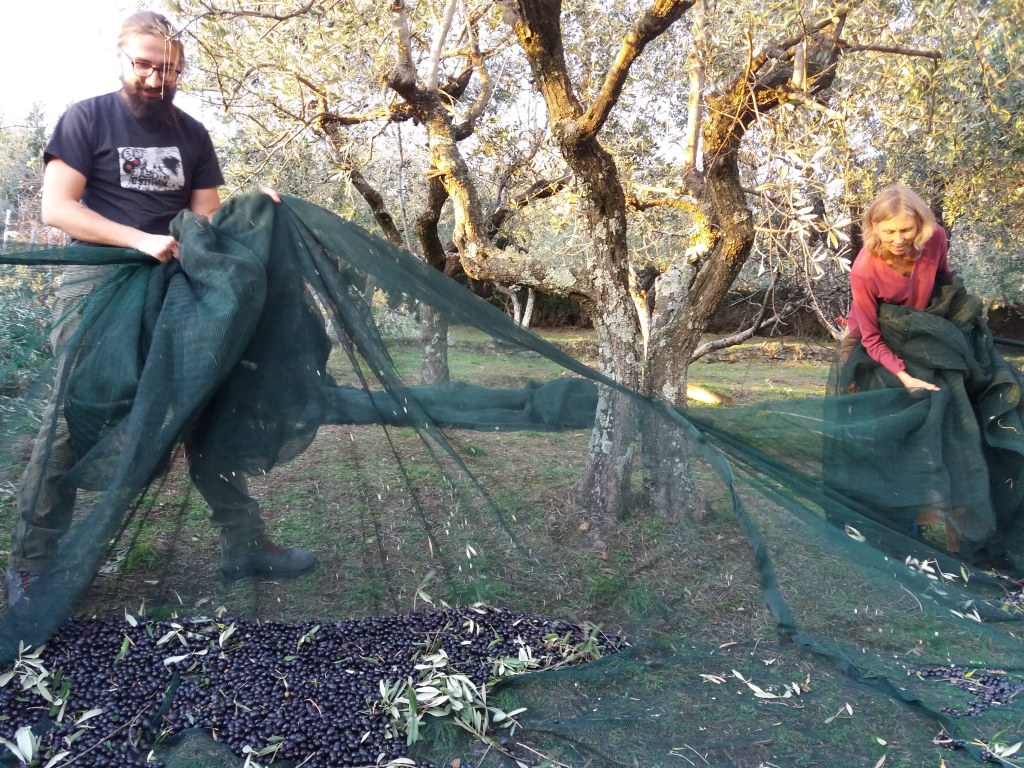
While Gianni and J work on a set of trees together, I take a bucket and climb a small tree to collect the olives, taking care to stay close to the thicker trunks and branches. Some trees are easier to climb than others, mostly depending on how they’ve been pruned over the years. Generally for fruit trees one aims for three to four main branches that grow outwards leaving light and air to circulate in the middle. We pruned most of our trees last spring. Those we didn’t prune are dense with small branches that have to be cut off in order be able to reach the greatest number of olives. Those too high to reach are cut and raked off the fallen branch.
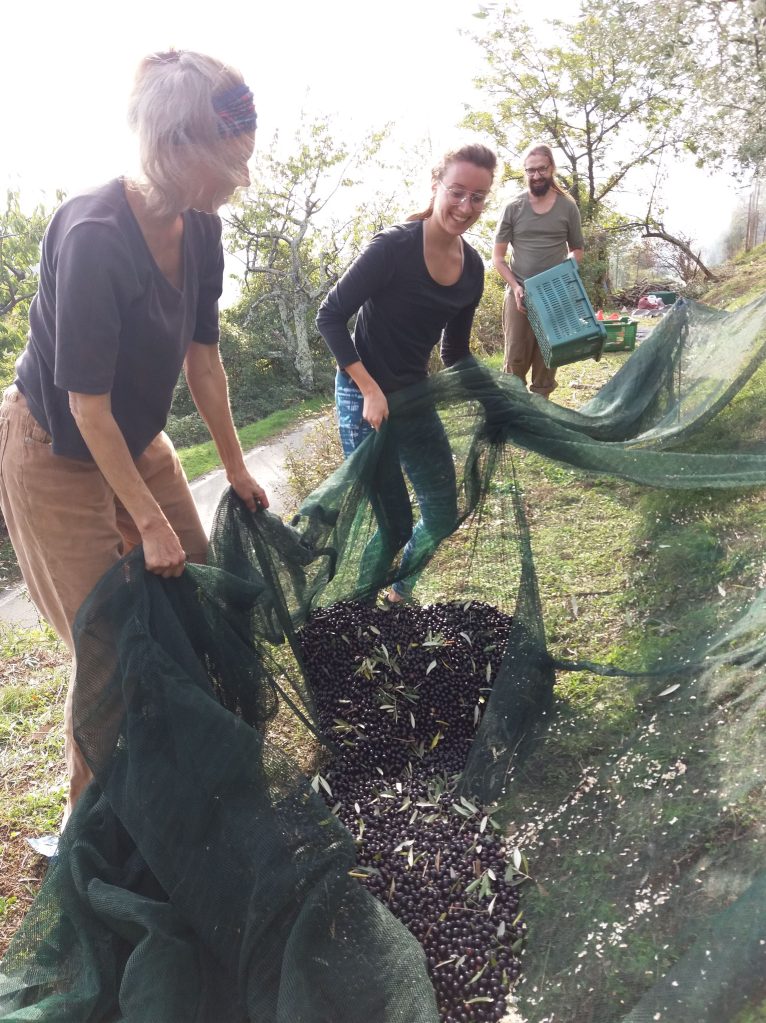
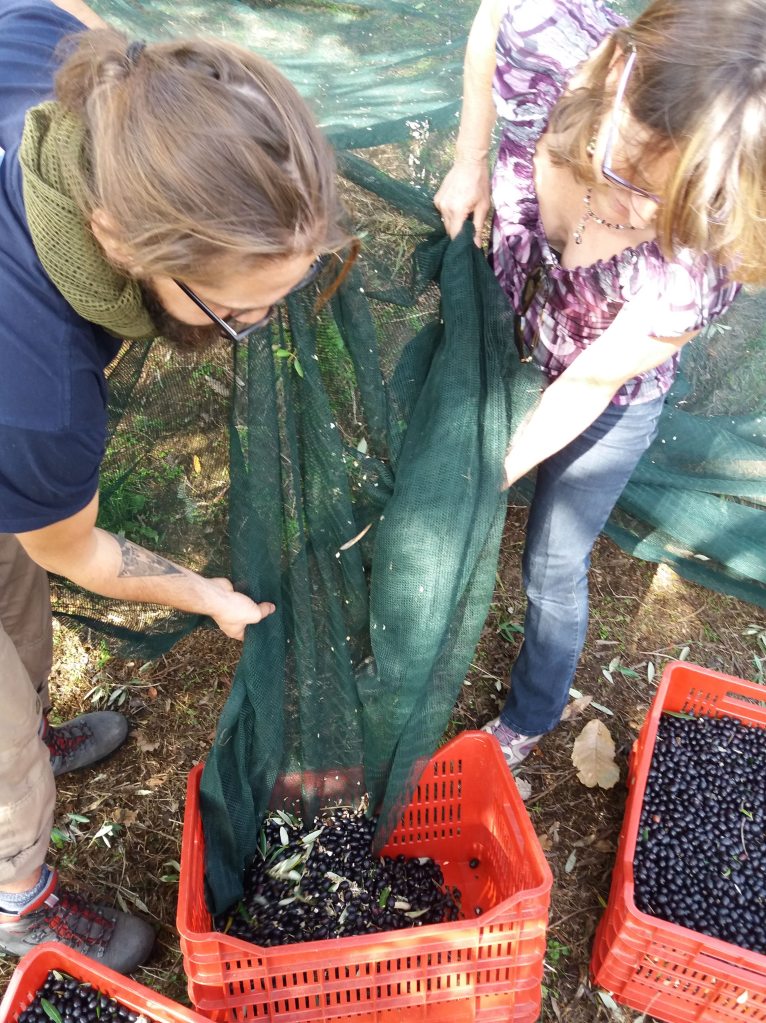
Once we have picked the trees ‘clean,’ we gently lift the nets to roll the olives into a pile at the edge of a net which can be lifted to pour the olives into a plastic crate. Then we move the nets and start again with a new set of trees until the plot is finished and we load up our gear and head to another plot.
A jeep passes by with a friend on his way to finish one of his plots. “Finish?!” I say.” You really start early in the season.” “The young green olives yield less but the oil is of a higher quality. And we only pick the green varieties for now.” It turns out he is more interested in producing high quality oil to sell than to make a lot for his personal consumption.
And over the years the taste for what is considered good oil has changed. Two years ago, when we started harvesting in November, I was a bit confused about a memory I had of harvesting olives about 40 years ago in the December sun until our friend Graziano explained that in these hills December 8th had always been considered the start date for harvesting olives. It was a good time to do it because the olives were really ripe by then and therefore yielded much more oil – lovely golden olive oil. Nowadays, the trend is towards picking for taste: the greener extra virgin oil with a slight edge is preferred. Though doubtless, global warming is advancing the season as well.
The weather is cloudy, for the most part, with a cool breeze and an occasional mist, but we enjoy the company and getting to know Gianni’s parents who come to help each day. While we work, we share stories, news, recipes and chocolate all the while keeping a healthy distance from each other. Even Gianni’s nine-year-old stepson comes to lend a hand. Neighbours drive by in tractors and wave. On our way home one evening, we pass a grove where friends are packing up from their day – about eighteen burlap bags full of olives line the side of the road. We exchange greetings and compare each other’s progress: their electric rake is certainly efficient.
Moving from one plot to the next, each day we prune, pick and gather up the olives until sunset and are tired by the end of it. Each morning we return to our trees, happy to see each other and ready to continue the harvest. Over the course of four days, we collect altogether 536 kilos of olives, enough to press at one of the local olive presses which require a minimum of 300 kilos.
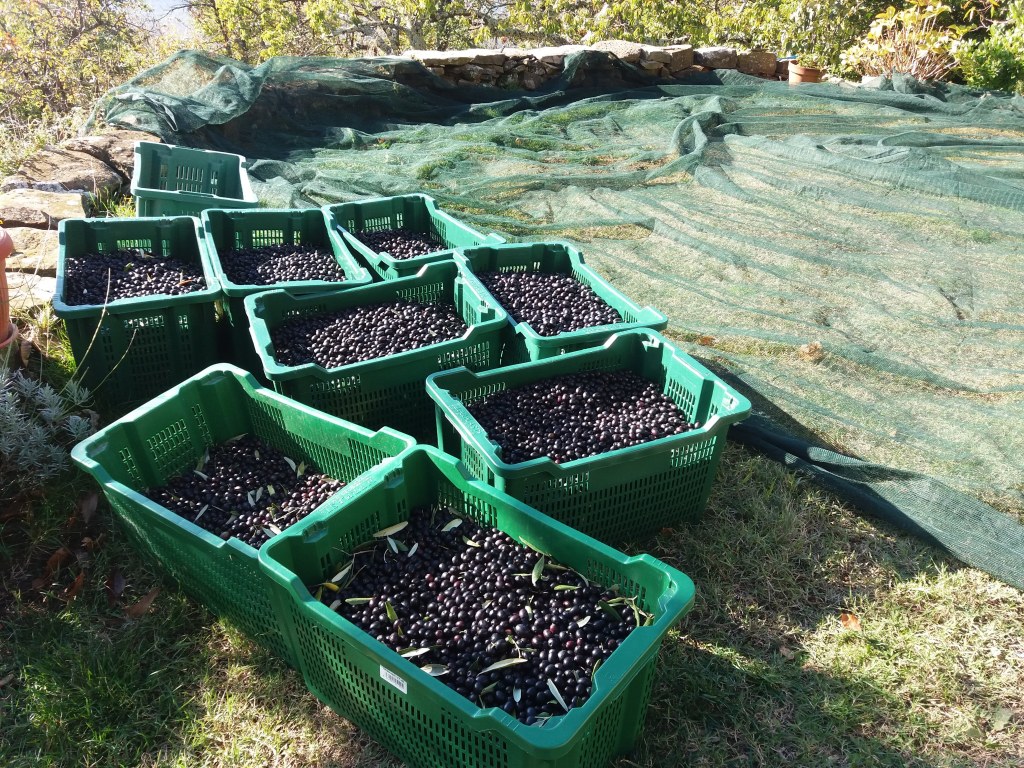
Going to the frantoio is the culmination of the harvest. Gianni booked us a slot at Frantoio Leonardo over a week before we started picking in order to ensure that we would not have to store our olives a long time while waiting to press. This frantoio is one of many of the small Tuscan presses that extract the oil mechanically at a low temperature which makes them famous the world over for producing the highest quality olive oil – cold pressed, extra virgin.
Two years ago Frantoio Leonardo hosted an Argentinian and a Chilean who wanted to learn about the Tuscan process so that they could replicate it in their own countries which up to now have used the Spanish heat extraction processes. Much of the quality of the olive oil around here depends on the method of cold-pressing, but I think the pride that Tuscans take in the olive harvest also plays a part. No matter how small an operation, how few trees, they watch the ripening olives carefully choosing just the right window for picking. Also, they don’t like to let their olives sit for more than a few days before pressing. After all, if you are going to go to the trouble, you might as well get a high-quality oil.
This year our frantoio is more chaotic. Dressed in matching white hats and white crocs, the two sisters who run it, both in their eighties, are overwhelmed by a recent power outage. It has put them behind in their tightly packed pressing schedule by three hours. Lacking the extra help from abroad it is difficult to catch up. And with the COVID rules, they are having to make sure that no more than two customers are in the building at a time while fending off last-minute requests to jump the queue.
Our olives are sitting in two large bins with our name written on masking tape on the outside. Delivered the night before, they’ve been weighed and are stacked one on top of the other. We take our stainless-steel olive oil urn out of the car and join Gianni and the other customers under the wide awning to stay dry from the rain. All are wearing masks and all are waiting for the fork-lift to pick up the stack of bins containing their crop. Two women who look like mother and daughter are in intent discussion with the man driving the fork-lift. One man seems to be arguing with the older sister, the one with the clipboard. Several other men stand on their own either looking at their phones, watching the goings-on or exchanging a few words with the nearest customer.
Gradually, the anxiety of ‘mine’ and ‘when?’ dissipates and everyone relaxes into the wet morning of waiting. Farmers drive up with flatbeds and vans loaded with crates of olives. One of them with a particularly cowboy-like nonchalance to the rain arrives on a small roofless tractor. Sporting a pair of bright yellow rain pants and a plaid shirt, he flashes a self-assured smile from under a brimmed leather hat before starting to unload his crates of olives from his trailer into one of the large grey bins.
The fork-lift carries a stack of newly filled bins to the scale to weigh them, tooting a tall man with long scraggly hair. Dodging the fork-lift, the gangly man strides over to one of the old sisters, asks a question, is given a curt answer and withdraws. He looks out of place in short baggy trousers and socked feet, one yellow and one red, slipped into Birkenstock sandals. “Perhaps he’s an elfi,” whispers Gianni. It’s a good guess. The elfi are an idealistic group of people who live sustainably off the grid in an isolated mountain community. They make do with little and whenever I’ve seen them in the city playing music for small change, spritely, barefooted, with root-like hair, they do indeed resemble elves.
Finally it’s our turn: the grey bins are brought to a large square drum and tipped into it. I smile as I watch the pieces of masking tape with our names join the row of many local names pressed before us. Our olives drop down a shoot at the bottom and land on a moving belt that carries them onto a tray where they are shaken vigorously so that a large fan can suck all the leaves and twigs out. From there the olives get rinsed and crushed up and then make their way into a stainless-steel barrel. Frantoio Leonardo is small and has only four. Each one holds up to 600 kilos of olives so our crop fits into one barrel. Here the olives continue to get mashed and churned very slowly to allow the tiny oil droplets to clump together.
The temperature and humidity are monitored carefully by a worker in green coveralls wearing ear protectors against the deafening noise of the machines. He moves steadily back and forth between barrels, centrifuge and a panel of digital gages and levers. Depending on the kind of olive, this churning process lasts anywhere from 30 to 50 minutes. Then the batch from one barrel at a time is emptied into the long cylinder containing two stages of centrifuge. The first separates the solids from the liquids and the second, the water from the oil.

After about an hour, we are called into the building to collect our oil. Placing our urn under the tap, we open it up and out flows the liquid green gold with its heady thick smell of leaves and earth and hot languid summers. The last part of the ritual is to weigh the oil. This year our yield is “10.7” which means that from 536 kilos of olives we’ve got about 54 kilos of oil. We’re not surprised by the relatively low yield because September and much of October saw quite a lot of rainfall which means the olives had a higher percentage of water when they were first weighed. To convert the kilos into litres of oil, one multiplies by .93. Oil, I always have to remind myself, is lighter than water.
As I go to pay (according to the weight of olives we brought in), the Birkenstock elf wanders into the office holding a pan covered in foil. Bashfully, he offers the contents to the sisters with a thank you. I smile at his kind gesture. He has brought them the traditional castagnaccio, a chestnut cake with rosemary and pine nuts, a celebration of another on-going autumn harvest – chestnuts.
Arriving home, we carry the oil urn to our tool hut where it will stay cool. The oil should rest for several days before being tasted. Some people will even wait until after the first decanting a month later when much of the sediment has settled to the bottom. Purists will even do a second decanting after three months as sediment is said to affect the flavour or even turn the oil rancid. However, olive oil will keep for a long time as long as it is filtered and stored properly at a cool temperature away from the light.
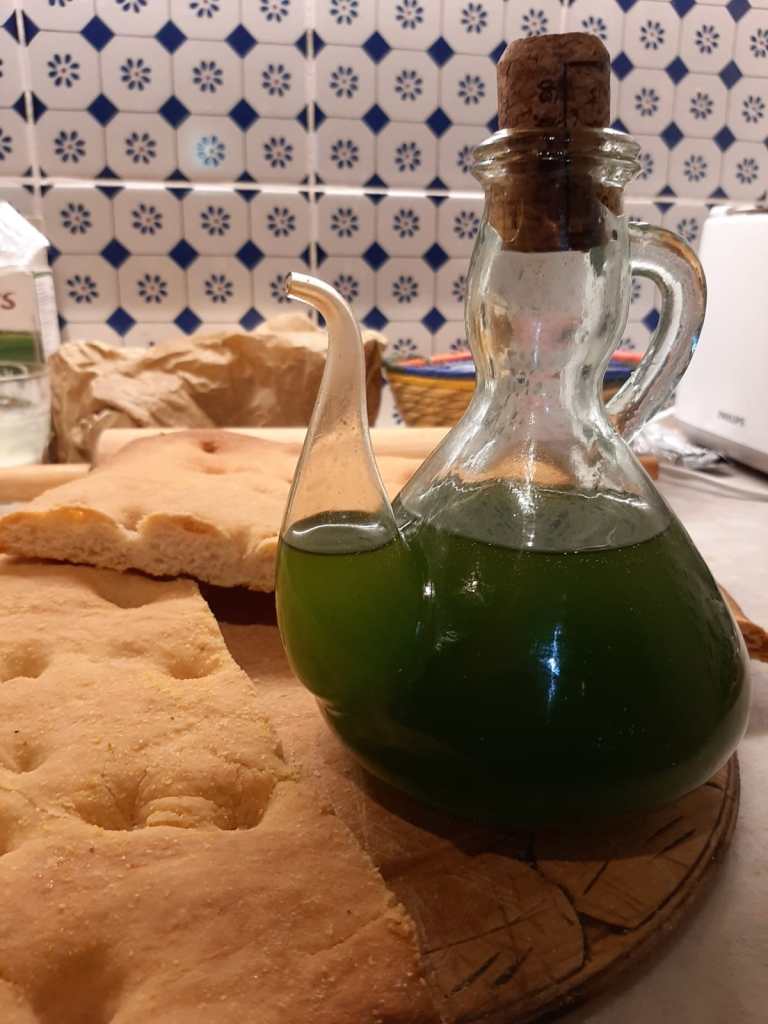
But we are not purists. Instead J bakes some sciacciata (aka focaccia) for our taste test. If we were true olive oil connoisseurs, we would pour a little into a cup and warm it in our hands to body temperature before smelling its aroma and then gently sucking it through our teeth and across our tongue to properly judge its quality. By contrast, we are plebeian in our ritual, preferring to douse a piece of the white bread with our new green gold, taking a bite and savouring the flavour. The taste is full-bodied with a peppery edge. Like its smell, it embodies the rich warmth of a Tuscan summer which coddles the olives from their slender beginnings to their plump ripeness in the flaxen light of autumn. Such satisfaction.

 Olivia's Journal
Bliss. We have friends who have a farm in a place called Gianno and were supposed to go this November to help them harvest their olives. unfortunately, covid…so next year God willing
LikeLike
Maybe next year you can stop by on your way and help us too!
LikeLike
lovely description of important work, thank you Olivia. Beautifully written as always!
LikeLike