
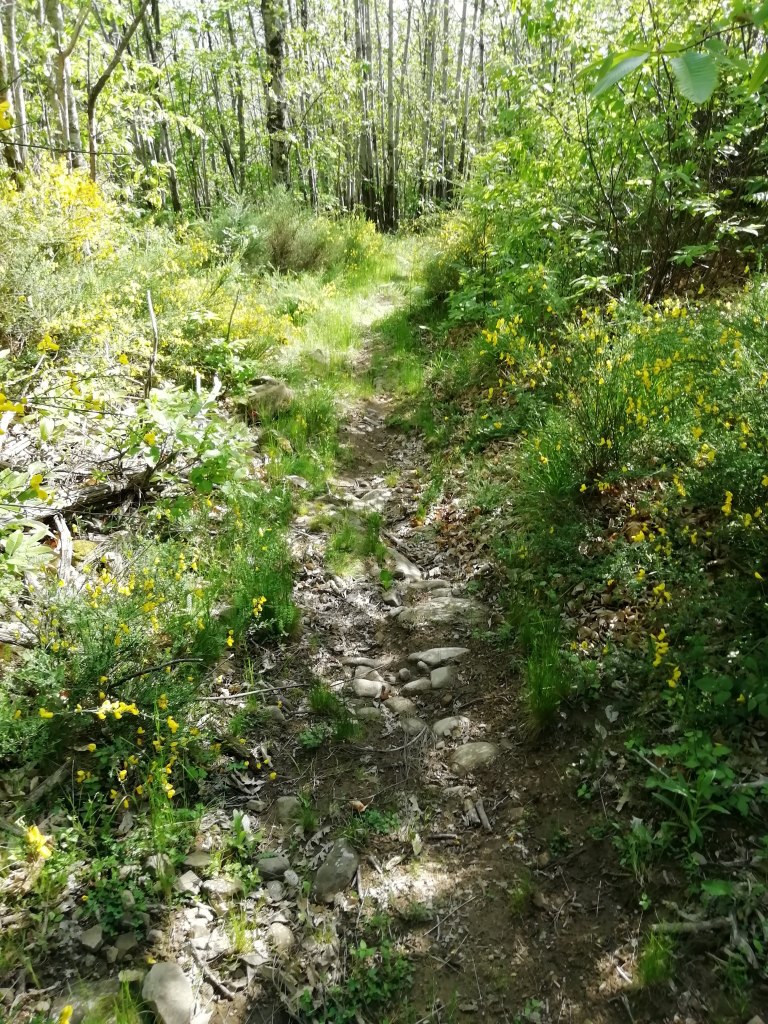
A multitude of paths criss-cross these mountains, each cut for a specific purpose. Traders, pilgrims, shepherds, gatherers of wild foods, hunters, charcoal makers with their mules, woodsmen, hikers, and of course wildlife, have travelled these paths over many centuries. Of all the trails leading up our mountain today, the Via Baiana is historically the most prominent.
La Via Baiana is probably one of the oldest trails in the large province of Pistoia whose valleys and mountains were settled by Ligurians and Etruscans as far back as the 6th century BC. By the 2nd century BC, it was almost certainly used by the Romans to cross the Apennines from their military camp in Pistoria (the city’s latin name) to the Bologna valley for trade and military purposes. Ransacked by the Goths, ruled by the Byzantines, Pistoia eventually passed into the hands of the Lombards in the 6th century AD. Throughout, La Via Baiana continued to be used by local merchants hoping to avoid the bands of robbers known to assault those taking the more direct route over the lower passes between Prato and Bologna.
By the 10th century, an order of Benedictine monks had established the monastery of La Badia a Taona at the top of our mountain. Much like samurai, these monks in the early medieval period are said to have defended travellers along La Via Baiana from robbers and offered them refuge for the night. The recently discovered ruins of a smaller monastery in its vicinity and the hospice of Spedaletto indicate that at one time there may have been a network of religious communities (interspersed with villages) in these mountains making La Via Baiana also a route for pilgrims.
Countess Matilda di Canossa was a strong warrior and intelligent woman who ruled from 1055 to 1115. Her domain encompassed much of Lombardy, Tuscany and Emilia Romagna. Although a feudal Margravine, she was beloved by her vassals whose courage and loyalty defeated all those who tried to invade. She also had a very close relationship with the papacy and as an ardent Catholic, often visited her confessor at La Badia a Taona. Oral legend tells of Matilda taking La Via Baiana passing through our small hamlet and stopping to drink and water her horses at the fountain here.
By the early 15th century, iron forges were being built in the mountains north of Pistoia. With plenty of wood and water, this was an ideal area for ironworks. Cosimo de Medici saw the economic opportunity of this industry and in 1543 signed a contract that gave the Medici state a monopoly over the iron industry in these mountains with the ore being brought from the island of Elba. Suddenly, subsistence farming could be supplemented with charcoal-making for use in smelting. The round “piazette” (little piazzas) found throughout the chestnut and mixed forests in the Apennines and the trails that lead to them can be traced to this activity.
People in our village had eked out a living off of farming and animal husbandry until this time. Making charcoal allowed them to earn and although they earned a pittance, it was better than none. Over the next few centuries, the industries that relied on charcoal multiplied. Landowners sought charcoal-makers to turn their woods into profit and groups of men from our village, often with boys as young as seven, hired themselves out to work all over Tuscany, Sardinia and Corsica. They built primitive camps to live in over the winter months, learned to keep their own accounts, and passed down the art of making charcoal from one generation to the next. In the summers they returned to their villages to see their families and to help them in the fields and woods to secure shelter, food, and warmth for the following winter.
For the women, children and old people left behind in the village the work continued into the autumn with the harvesting of chestnuts which were dried slowly for about a month in drying huts and then milled into flour to be eaten as a porridge or flatbread. Mushrooms and winter fruits were collected, wood chopped and stacked, animals tended and cheese made. Sheep were shorn and their wool was carded and spun to be knit into undergarments, like long underwear and socks, and shawls and hats. And with the return of Spring, the fields were prepared and sown and the growing season would begin again.
Such were the cycles of the village until they were interrupted by World War 2. Like many villages in the Apennines, families were divided between partisans and fascists but tried to keep the uneasy peace rather than risk violence which could lead all too quickly to the extermination of a population. In the autumn of 1944, German troops retreated up the Via Baiana. Children greeted them along the path, distracting them with their questions and playful antics. This gave the partisans time to hide before the Germans passed through our village. Watching them march past, the women feigned loyalty and told stories of husbands off at war. Up the Via Baiana the troops continued to the top of the mountain where they dug in their heels for the long winter ahead.
Using the old trails during the winter of 1945, courageous young women climbed to the top of the mountain ostensibly in search of lost sheep. In reality they took note of the position of the German troops along the Gothic line, their numbers and their ammunition. These details they furnished to the partisans who radioed the information to the Allies.
Using the old trails during the winter of 1945, German soldiers descended the mountain to demand food to feed their forces. Even though many families were sheltering relatives as well as themselves, they had no choice but to give them a week’s batch of bread, the only goat, the last bottles of their oil. Everybody was hungry.
After the war, more and more families abandoned the hillside for the economic opportunities of the cities and of the manufacturing industries. The once park-like forests, tended for their wood and their fruits, were left to grow wild and decay. Deer and boar, wolves and foxes, badgers and hedgehogs and porcupines roam more freely.
A few years ago, a group of people from towns and villages in the mountains just west of us decided to make a pilgrimage route dedicated to Saint Bartholomew. This saint was first really honoured by the Lombards who built churches in his name and today he is known as the patron saint of children. The Via Baiana makes up part of the final day of the 100 km Cammino di San Bartolomeo that ends in Pistoia. Pilgrims once again follow its ancient path.
Hiking the same trails throughout the year brings many discoveries, the most marked one being the seasonal changes. In the summer, the languid heat discourages walking except in the mornings and evenings when birdsong and the angled sunlight across leaves and mountains offer a paragon of nature. The transitional seasons of Spring and Autumn add their parades of colour to our paths, while Winter is the best time for exploring. The underbrush of brambles, broom, and bracken has died back making the smaller, wilder paths easier to follow and wildlife easier to spot.
We look for trails that join each other to make hiking loops, but it isn’t as evident as it seems. The paths branch out like tributaries. Many of the old ones made by the charcoal makers and woodsmen lead to a level rounded area where wood was stacked before either being made into a charcoal dome or being hauled out by mules. These trails are very distinct but dead end. Always, whether smaller or larger, the paths converge and diverge, some more worn by hunters of deer or boar or mushrooms, others vanishing into brush or ending at one of the steep gorges cut by rushing streams difficult to cross. The wildlife also add their tracks, often steep and less hospitable to humans. Some trails have been bulldozed into forest roads.
Despite the challenges, we have managed to find a couple of loops and to restore an abandoned track of the Via Baiana. The work requires clearing away fallen trees, cutting back brambles and brush, making sure loose rocks, eroded edges and slippery descents are adjusted so that they don’t pose a danger and then the route is marked with cairns.
As we explore the worn, narrow furrows of trails criss-crossing under generations of chestnut and beech trees, we are left to imagine the many comings and goings to which they’ve borne witness. And as we uncover new routes, we are humbled by the thought of all the activity and lives these mountains have sustained for nearly three thousand years and wonder in this vast landscape of history, what effect our tiny efforts will have, if any, on the constantly evolving future.

 Olivia's Journal
Olivia, another very different type of writing, and what a fascinating piece of historical research. Very interesting to know more about the Via Baiana, to add to our happy memories of walking on it. There’s so much in this piece! I love the idea of Matilda drinking from the spring above your house and the ‘Samurai’ monks at La Badia. And the stories of the war are extraordinary, such courage and quick thinking of the part of locals. Did you research it through the internet, and local people’s stories?
And I particularly liked hearing about your path-hunts. Aren’t paths extraordinary? So many, and so much written into them, all over our countryside. People-paths, sheep-paths, badger-paths…Rescuing them is noble work, especially if new life can be brought to them by pilgrims and walkers. Lockdown has developed our local paths. The faint ways into the wetland beyond the Pells have been trodden into full-throated paths by people, especially teenagers, wanting somewhere to meet out of sight. The riverside path now has a hard surface (sandy gravel, not tarmac, thank goodness) to just beyond the first gate. It’s been very busy all winter, but the mire that meets walkers just beyond the gravel is deep, and it’s not unusual to see people tugging desperately at their wellies to liberate their feet. As a result, a series of little paths have developed on either side, picking the driest routes across the meadow and riverbank.
Keep writing! Clare
________________________________
LikeLike
Thank you, Clare. Most of the information about the paths I’ve picked up from locals and from living here. I love your description of the paths around the Pells and along the river. It’s interesting to think how, like meandering waterways, paths too change course for all sorts of reasons and for various lengths of time. I even see that happening here. For example, forest roads are easy for people to follow but that means that the old tracks are often abandoned. It takes work to keep a path clear from brambles, fallen trees and loose rocks. Even with the via Baiana — had it not become part of a new pilgrimage route, it might have slowly been subsumed by the wilderness. xOlivia
LikeLike
What a great choice for your latest blog. Many paths have such deep history, but often it is hard to unravel, layer lying upon layer upon layer. Your account is a triumph of research and written so elegantly and engagingly. Though we have talked often about La Via Baiana, I have learnt much of interest here. I look forward to walking it again with fresh insight.
LikeLike
John, the old people in the village are a wealth of information and are happy to describe the favourite paths of their younger years using the local names for places that have become obscured with time. When you next come, we’ll see whether we might discover more together.
LikeLike