

Circles have no corners to hide in, they are not hierarchical, the line is coming together, a round of song, a spin in a dance. Circles can be oval or elliptical too, they might loop and spiral, and although they seem to close, they never quite do in the way you expect them to. Circles are a way of writing with flows and eddies and coming home again. Circles are a way of seeing.
Several years ago, my son got married and I decided to make a quilt as a wedding present, a friendship quilt to which their closest friends and family would each contribute a patch. To me it seemed a fitting gift signifying the importance of the community of family and friends who witness our lives, our pains and our joys, and who celebrate with us the rituals that mark important passages. Certainly, for me, this is one of my most important circles that sustain me. The love, both gentle and tough, of my family and friends continues to carry me like a raft on the gentle and rough waters of Life.
The first step was to choose a pattern for the quilt and one of the first patterns that I considered was the double wedding ring. Each ‘wedding ring’ is made up of little colourful pieces of fabric and each of these rings overlaps with the four rings around it. The spaces where they overlap (as in a Venn diagram) are pointed ellipses, almond-shaped ‘mandarla,’ leaving the center of each ring a curved square or diamond. Traditionally, these spaces are white fabric which is quilted with a pattern.
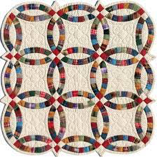
My life is a bit like a (multi-dimensional) double wedding ring quilt with many different overlapping circles that surround, sustain, and embrace me. And the white pieces of space and silence in between are as necessary as the colourful patches. Much like trees that need space in which to grow, I need meditative silence in which to connect to my inner self also an essential part of balance, renewal and growth. And I need the space to allow my being to inquire, reflect, dream, and express dimensions of light and dark, contraction and expansion, sinking and lifting. I have been fortunate to have guides and teachers, including friends and family, who have challenged me to find my wiser self. This is my personal circle, the one which touches all others.
Home for me is this mountainside, more specifically the land we tend, the village we care for, the wilderness we watch. The wilderness with cycles larger than seasons, cycles of human involvement, of shifting diversity, of managed tidiness and overgrown abandon. Travelling along its marked and unmarked trails is a gift allowing me to observe nature in its wanton glory, notice myself within it, part and yet not quite part, and sense a third dimension that is greater than what I see. Walking these solitary paths is like a pilgrimage for me where the personal, collective, universal intersect. Perhaps this is why pilgrimage routes lead through nature, like the one that winds through these mountains with its forests and streams towards and past our village.
Trees rooted in soil, water courses, shifting currents of air. Our mountain forests are a majestic universe of visible and invisible cycles and loops and spirals. They become an easy metaphor for the community which we are a part of. At the moment, our village is an old tree with many limbs that are worn through time. These limbs represent the people who for reasons of age, work, unforgiven disagreements, disinterest, or lack of time do not engage with the needs of the community and prefer to stay uninvolved. Although a few younger and more vigorous branches grow towards the open spaces, if we do nothing, we risk that the branches will die and there will not be enough new growth to sustain the tree. We must encourage regeneration and renewal by pruning deliberately, and not too drastically, to let in light and air, space to grow towards. What does this mean in terms of the village?
In our village over 40% of the population are over 70 years old and of the nearly 80 families that live here, only 8 have school-age children. Furthermore, many inhabitants are not involved in village life, events and community projects. This was not always the case. Up until about 5 years ago, a large group of volunteers served pizza every Saturday and kept the bar open every evening throughout the summers in addition to hosting crowds at special festivals. After thirty-five years of volunteer work, the village council had saved up enough money to build a two-story community center with a professional kitchen and a bar. Now with only a handful of volunteers, we are struggling to open the community center except for special events. Although weathering the fickleness of relationships, the brittleness of emotions, pain and disappointment is part of growing stronger together, we need to prune away apathy. To revive interest and encourage participation, our council is working on a collective vision for the future, one that is sustainable and that is grounded in the identity of this ancient mountain village yet growing and adaptable, like a tree. We hope to restore faith that working with the constantly evolving nature of where we live can be enriching and rewarding.
To this end, we need only look to the overlapping cycles of history and of nature. At the start of my lifetime, this mountain was well-tended. Sheep kept pastures open, forests were managed for their wood to burn, to build or to make into charcoal, fruit was collected and trees were pruned, trails were kept clear by hunters and foragers. The locals built their houses mostly from the materials to be found on this mountain – dry stone walls and wooden beams. After WW2, people moved toward new opportunities in the cities and the mountain has slowly been rewilding.
We have been restoring a part of the village and land that was abandoned using local materials and local methods. Like many of the old farmers in our village, we are learning that tending the land is not so much about what we harvest from it but establishing a symbiotic relationship with it. It’s about learning how not to waste and to feed back into, so the brush left over from coppicing and pollarding for firewood we use to make terraces, leaves and grass clippings become mulch, nettles are excellent fertiliser and pesticides. It’s about learning to be observant, to listen and ask questions, to try, to fail, to reflect, to persevere. To step into the circling of its cycles and skip to its rhythm.
Of all the circles that sustain me, perhaps this is the clearest one because so much of the work is seasonal. I also feel more clearly the changing needs of the earth. With summers growing hotter and drier, clean water becomes a limited resource. But we are used to unlimited amounts piped right into our homes. In a hot summer, many people shower every day, water lawns to keep them green, hose cars to keep them clean. What can we do differently? We catch rainwater in large cisterns, use drip-feed irrigation and mulch to keep in the moisture. We save rinse water from our dishes or washing vegetables to pour on our flowers, leave our grass to get dry. What more? Can we take one-bucket showers? Might we wash our car with left-over water?
Working this piece of land encourages me to reflect on consumption and waste and how to close that circle. Human manure passes into treatment plants while chemical fertilisers are poured onto crops. Here we compost our organic waste and use a biological septic system. We shelter bees in a pesticide-free environment and thank our chickens as much for their eggs as for their valuable fertiliser. We save old windows, doors, furniture, boards, fencing, fabric to use for repairs or to repurpose. In our chickencoop-greenhouse, we reused 8 windows, half of them saved from an office renovation, and 2 old doors. My parents’ leaky greenhouse has been repurposed into a storage shed with a new roof on it. The stones around our fireplace used to be steps in an old palazzo that our builder saved from a renovation job. Keeping scraps of fabric and wood on hand make repairs easy and come in handy when creating home-made gifts. I have reduced the number of new clothes I buy, preferring to treasure-hunt in second-hand markets and using worn clothes for work or mending and patching to keep well-loved clothes presentable.
Yes, I am privileged to be in a place and class in which such decisions are possible for me to make. As my daughter pointed out the other day, the number of vegetables she can grow in her city garden the size of a postage-stamp does not lower her food bill. In fact, the price of food is so low because it is subsidized to keep the poor fed (barely, some would say). The prices do not reflect the cost to the environment of how it is grown or transported, nor the cost to the low-wage workers in the supply chain. Buying organic, healthy foods should not be an economic privilege, but it is.
And this goes with most goods in which low cost versions are often produced at a high cost of human exploitation and environmental degradation. As part of this giant net of consumerism, we need to find a way to help the behemoth multi-nationals shift towards more equitable and sustainable production and demand that governments encourage this too. Why should we pay higher taxes on renewable energy than on non-renewable sources (like gas)? We are still stuck in systems that are so focussed on the cycle of short-term profits that the larger cycles of long-term costs are not adequately considered and all of us are paying the price. All of us are unknowingly or unwillingly complicit in this destructive system because it is nearly impossible to extricate ourselves.
I am by no means self-sufficient or fully sustainable. My circles are linked to the wider world and its economic and political systems that also sustain me and to the very great challenges that face this planet. Two such challenges are the current COVID pandemic and the on-going climate crisis. What insights can I draw on from the circles of my life to apply to these situations? As I see it, both require from all of us a shift towards more empathy and cooperation. The culture of competition and individualism infuses almost every part of our societies from education to manufacturing, from sports to politics. It pitches each of us against “the other” whether in academic success, university selection, world series, jobs, political parties, or war. Competition in and of itself can be healthy if it is kept in balance with cooperation and service. Unfortunately, however, it has become the dominant way of perceiving the world.
Take COVID. In order to eradicate the threat of the virus, the majority of the world’s population needs to be vaccinated, and vaccinated in as short a period of time as possible because the probability is high that, left unchecked in even a few places, the virus will mutate into a more dangerous, lethal form. Hoarding vaccines so that the residents of one country will be immunised first will not necessarily protect them in the long run if a variant develops that is resistant to the current vaccine. Yet this is just what the UK, for example, has done as if in competition with Europe. Instead, what is needed, on an individual level is cooperation and on national levels is well-coordinated collaboration. Individuals need to wear masks and keep their distance not for their own safety but for everyone around them. Nations need to ensure that not only their citizens get immunised but all countries are able to do so in as relatively short a time as possible. Individual safety depends on what happens on the global level.
Similarly with the climate crisis. Countries who meet their zero-emissions targets should be applauded, surely. However, if only a few wealthier or more environmentally conscious countries do this, the planet will still suffer, the climate crisis will continue and we will be affected. The globe is round, it is a three-dimensional circle, and we who live on Earth are all connected. As such, actions by a few will affect many; coordinated actions by many can create change.
This last overlaps with my circle of hope which persists because of the children who engage with the world with curiosity and imagination, with trust and determination. I believe younger generations, inspired by individuals like the fearless Greta Thunberg, can and will persist in their vision for a healthier planet. I have hope when I hear that Iceland supermarket chain has cut palm oil out of more than 400 of its products. I have hope when a modest, seemingly conventional president astounds the world by proposing a surprisingly bold “Green New Deal.” Hope plays off fear, of course, and there is a lot to fear: the rise of fascism and the entrenched, self-serving relationships between corporations and politicians. But while branches of fear are riddled with creepy-crawlies, hope branches towards the light.
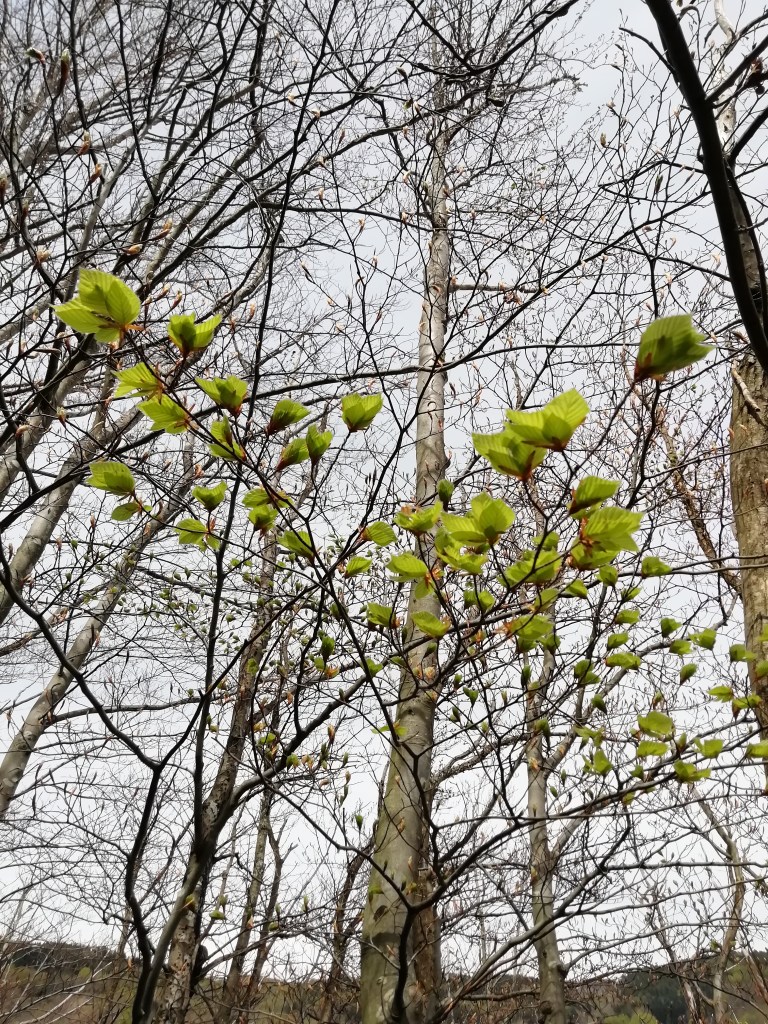
Leaves bud, unfold their wings, flutter through the summer and spiral brown to the earth, the dark silent soil where roots feel their way around stone and rock to fertile patches that offer the nutrients and microbes to sustain that which we see and that which we don’t, in the air and in the rain and in the sun’s rays filtered through leaves. Our behaviours and inventions have unwittingly upset the natural cycles, the balance of ecosystems, the global climate. Now we must knowingly work together to address our mistakes and together create a more equitable and sustainable future.
Circles are a way of being. They loop and spiral bringing us together in a way we don’t expect. A round of song, a twirl in a dance, a spinning wheel, a reassuring hug: circles include us and carry us, forward.

 Olivia's Journal
That was wonderful, thank you for sharing and for your insights. 💕
LikeLike
Thanks, Jenny! I’m glad you enjoyed it.
LikeLike
You touched my heart & my soul in so many ways.
Thank you Friend.
Lyn
LikeLiked by 1 person
Thank you, Lyn.
LikeLike