
Recently, I’ve been reflecting on what it means to me to live sustainably. I say ‘to me’ because I think there are many different ways and myriad choices in how one may go about it.
To sustain means to support and nourish, to maintain and keep alive. It involves not just the self but the other. Living sustainably means to live in such a way that you are considering the effect of your choices on the communities and the systems of which you are a part. If you stop to think about it, each of us is a part of many communities and many systems, some that nurture us and some that do not. Nothing exists in isolation.
I experience living sustainably as a process, at times creative, caring, personal, inspirational, or mundane. This process now is intentional, focused on the future, on change. In short, it’s life-affirming. And I don’t think it’s new. In fact, I think that humans have been trying in various ways to live sustainably not only for centuries, but for millennia.
One thing that I don’t equate with living sustainably is being self-reliant mainly because self-reliance has more to do with being and thinking independently to the point of not needing others. Living sustainably, on the other hand, has much to do with living not just in a way that sustains yourself but with an awareness of the network of communities of which you are a part. That is not to say that a bit of a non-conformist or rebellious spirit can’t be part of living sustainably, but self-sufficiency is not the goal.
However, questioning our patterns and habits of consumerism certainly plays a part in sustainability. The last time I returned to the US, I was struck by the amount of energy use that is taken for granted. Our country is huge, our landscapes are sweeping and with the abundant space, people have constructed lives with more than ample room — large houses, large cars, large fridges — all of which make a larger footprint. With our fundamental belief in individualism, people have gotten used to relying on cars, to buying whatever from wherever, to valuing convenience and choice. This has led to incredible sprawl, massive stores and malls, one housing development after another and each of these consumes energy and adds to the individual footprint such that five percent of the world’s population now consumes a quarter of the world’s resources. Is it possible for those who live in such consumer rich countries to pull back on lifestyles that are clearly impacting the direction of our global crisis?
Although I have been aware for decades that our planet is under increasing duress from the destructive, extractive habits fed by the need to control and to consume more and more lavishly, there was never a moment of decision to live sustainably. My lifestyle has evolved slowly in response to my growing realisation of our irresponsible damage to the environment. It has developed through observing, listening, imagining to improvising, trying, experimenting to remembering, practising, changing. An on-going spiral.
While my children were growing up, we did the usual recycling and trying to remember to turn off lights, small actions to do our bit for the environment, but we didn’t question our energy and gas consumption. I had my doubts about all the well-watered lawns that stayed green throughout the hot Oklahoma summers, and I preferred to hang up our clothes to dry when the weather was good to using a dryer.
Moving to England we discovered the ease and enjoyment of taking the train, walking and biking places, giving us more exercise and lowering our carbon footprint. We got rid of our dryer, started growing our own vegetables and explored local charity shops for second-hand clothing. Climate change was becoming a well-known issue and awareness of our ecological impact was growing. The supermarkets in our town started charging for plastic bags and we started bringing our own.
Now we live in Italy on my family’s old homestead in the Appennines. We put up photovoltaic panels, put in wood-fired heat and hot water and installed two large rainwater cisterns. We grow organic fruit and vegetables, nurture chickens and manage several bee hives. As we’ve become more involved in village life, we’ve formed new friendships and come to understand more about Italian culture and politics. We’ve also taken on some olive groves and are harvesting and pressing olives into oil.
Living in the country we have realised the need to reach out and welcome in. There is always the opportunity to create community, however temporary, to connect, however fleetingly. Besides our local volunteer activities, we host guests, travellers, volunteers, and pilgrims who pass by on a pilgrimage trail that we help to maintain. Hosting gives us the opportunity to share what we are doing and to learn about other perspectives. It’s an affirmation that we are all human and all part of this planet, that we exist in relation to each other through so many networks, virtual and real, natural and man-made. In the end, we’re all interconnected. If anything, that’s what the global climate crisis is teaching us.
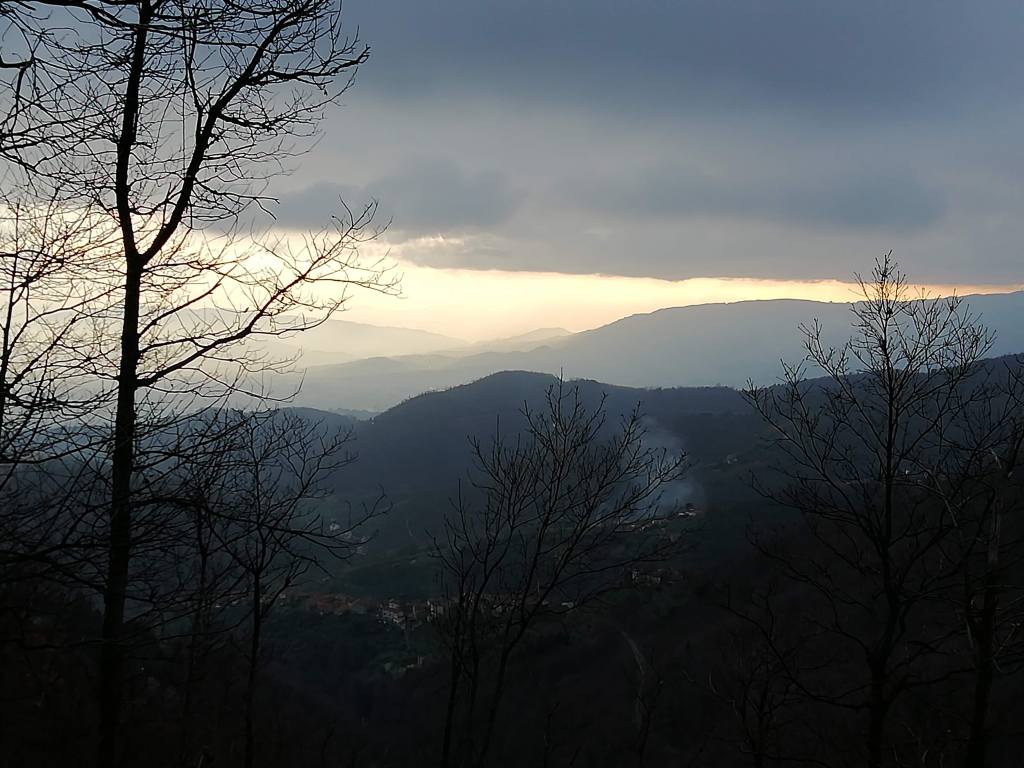
Yes, climate change has evolved into a crisis, an emergency. We notice it here, surrounded by nature with a view over the valley to southern ranges of mountains. The winter snows are fewer and disappear quickly; the summer heat waves have been getting hotter and more frequent to the point where last summer we lived under a heat dome for nearly ten weeks. By eight in the morning the sun’s rays forced us into the shade and then into the coolest, darkest room in the house until evening. In the intense heat and drought, we were severely challenged to sustain the animals and plants in our care. In our vegetable garden drip-irrigation was not enough; we added a shade awning over our garden that cuts out 50% of the sun’s rays. I covered the greenhouse roof with carpeting to keep our chickens in their coop at the back from over-heating. J moved the bee hives into the shade of the apple trees. We saved household water to pour onto the young fruit trees in a failed attempt to keep them from drying up and abandoned our flowers to the fates.
This is not an anomaly. This is not a new normal. This is going to get worse.
In our village, people gathered in the evenings on the terrace in front of the community-run bar in hopes of catching a light breeze. We held events — buffets, pop-up pizzerias, barbecues — and noticed some new faces amongst the volunteers. People seek to connect in uncertain times and I think everyone was unsettled by the heat. Surrounded by woods on all sides, we prayed that a forest fire wouldn’t break out as was happening all over the world. That prayer is on-going.
Am I prepared for this summer? Not really. Just thinking about it makes me anxious. I feel the weight of it in my body. All year we’ve been talking about what more is needed, what habits need to be shifted, what is feasible. We’re considering, prioritising and planning the next steps: buy a water-pump and firehose, plant drought-resilient trees and shrubs, shade the front of our house, install a heat pump, figure out how to save more of our house-hold water, create a forest-garden under the trees, look for a well, make a canopy for the terrace in front of the village bar.
Awareness, sensitivity and connection to the many networks are an integral part of it: networks of consumerism, transport, energy; networks of family, friends, neighbours, associations, colleagues, human beings; networks of plants and fungi, waterways and weather patterns, animals and microbes; a vast interlocking web.
And here I must remind myself that to really live sustainably, I must care for myself; tune into my heart; take care of my body, my mind, my spirit because if I haven’t the energy for that nourishment then I can’t give support to the many layers of community around me. Through this inner space, I realise that the challenges of living sustainably call on me to develop some key attributes:
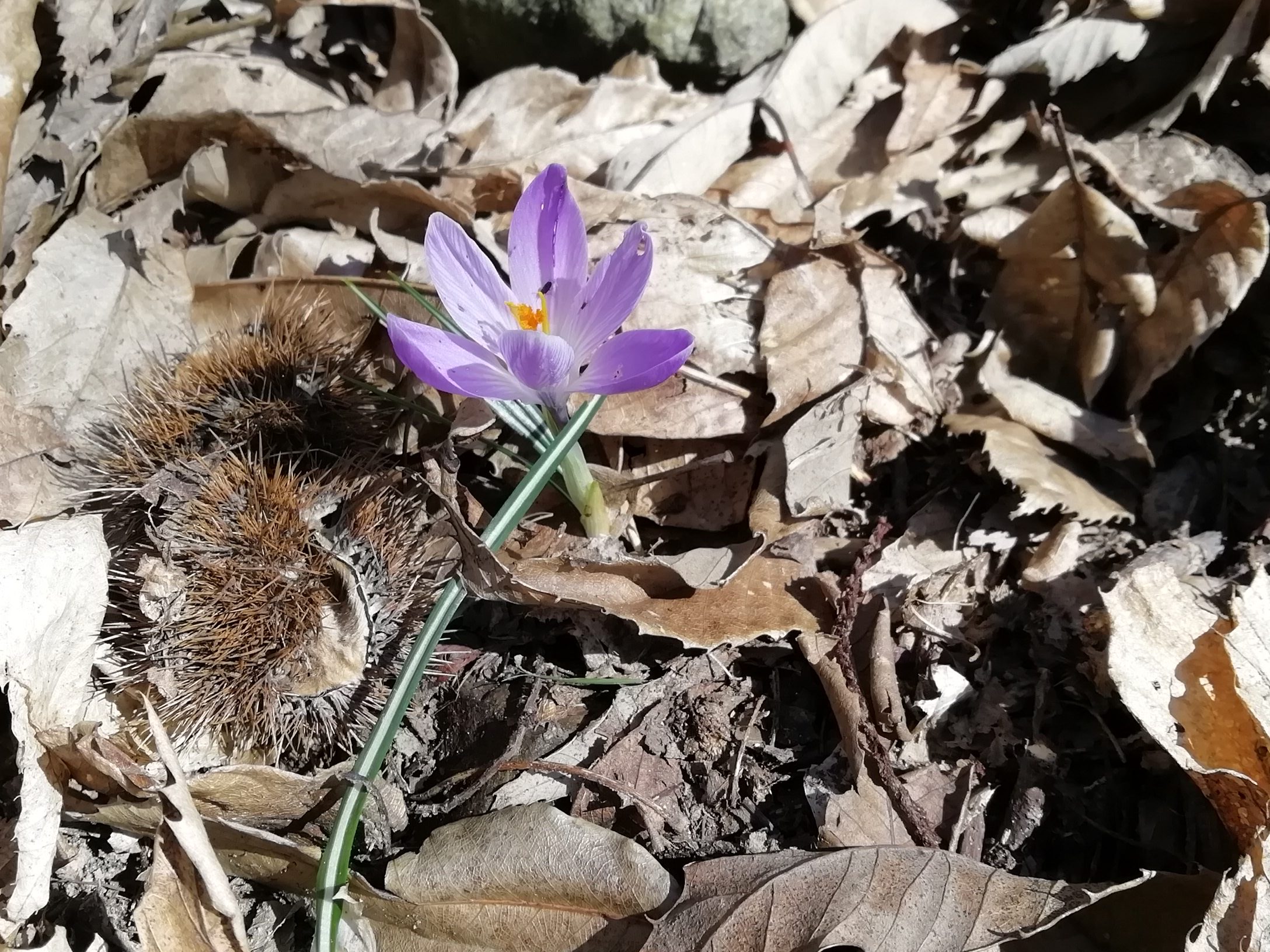
Resilience, with all its implications of surviving and growing through remaining flexible, aware and adaptable in the face of challenges.
Hope, not so much in the sense of optimism but with its aspect of faith that what we are doing will make a difference, however small.
Perseverance, which requires determination and hard work, not giving up, being stubborn, because, even in the face of great adversity, it’s worth it.
Love. Love leads to kindness and connection to all around us. Love our small, tender selves, love our pitiful attempts as well as our inspiring successes, love our fellow beings, our earth (worms, spiders, roaches and all), and the incredible beauty and diversity around us. Reach out.
The main thing is to realise that we make choices every day and those choices — almost all of them — are affecting our planet and our future. The response to a crisis often sends us into fight or flight and many of us are fleeing from this one. Depression and anxiety are common and natural responses to the daily news of the worsening situation. But these states of mind isolate us further from one another rather than creating supportive networks.
Instead, try taking a small step in a more sustainable direction. Find out what groups, organisations, communities, companies are trying to sustain human connection and environmental integrity. Support local efforts. Shave a bit off your footprint. Spend time with nature. Be kind. Nurture.

 Olivia's Journal
Thank you Olivia, I enjoyed reading this and agree with everything you wrote.
LikeLike
Thanks, Anne! I’m so glad you found it interesting.
LikeLike
Never realised you had it so bad last summer Olivia. It was bad here 45 d!
Loved what you said about community. Thanks
LikeLike