
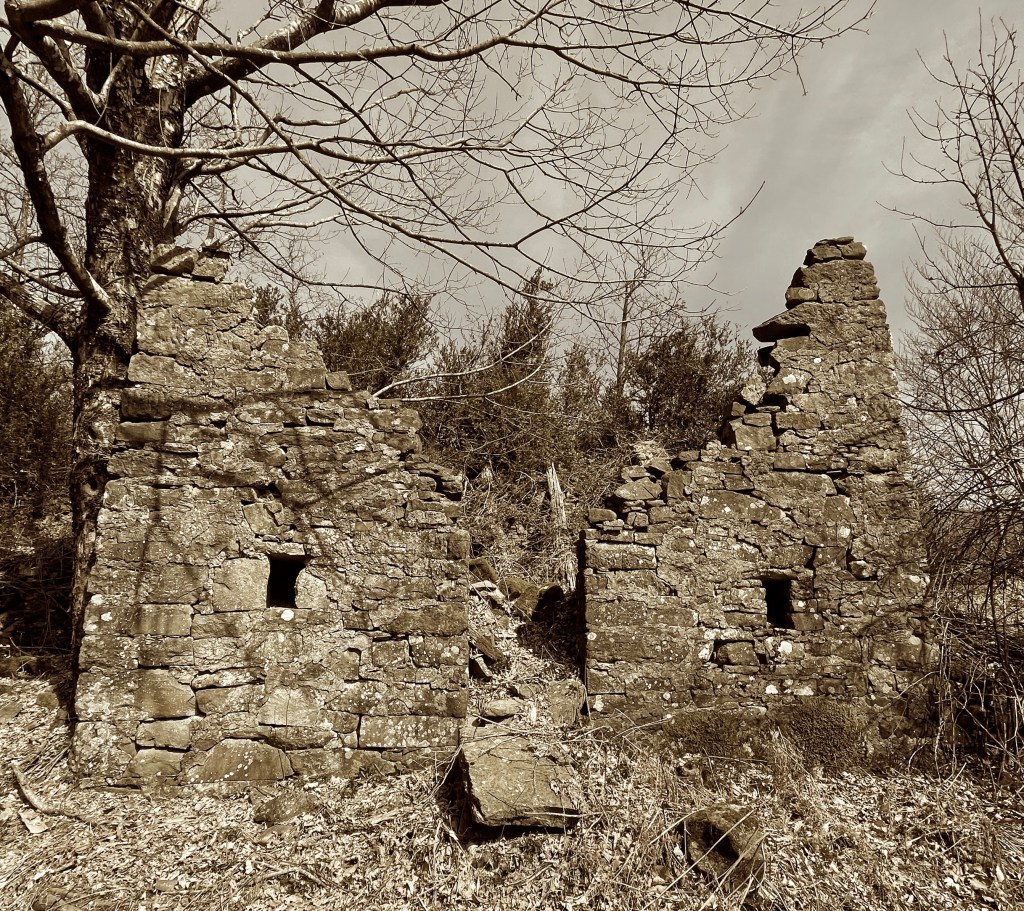
In this allegory, a conversation between a grandmother and her grandchild, I explore some of what makes a community strong, like its connection to place, and some of the reasons for its disintegration. A “girovago” is a wanderer, an adventurer, a drifter; in my story, a girovago is more of a poltergeist.
Girovago, the drifter
Nipo, I need my eyes.
I’m here, Nonna.
The spoon. I can’t find it. It must be here somewhere. It never wanders far from the pot.
It’s dark. But let’s look.
O Dio! The zuppa’s starting to burn. I can smell it. Where’s the spoon? Have you found it?
I’m looking, I’m looking.
Good. Remember to look Under as well.
Ok.
It must be right around here. Can’t you find it?
It’s dark, Nonna.
I know but the fire’s light is bright enough. O Dio mio, this zuppa’s going to burn. Just bring me a stick. Nipo!
I’m getting one.
Good. And peel the bark. Good. That’s right. Ah, just in time. Let’s hope.
It smells wonderful, Nonna, don’t worry.
That girovago must have taken the spoon. Nothing but mischief.
Just borrowed it, Nonna. It will be right here in the morning, just like always.
I don’t know what I’d do without you, Nipo. Dio mio. If it’s not one thing, it’s another.
That girovago is sneaky, no? We never catch him and even if we look for him, he has so many places to hide in all the empty houses.
Hmmm
But… don’t you think the girovago is lonely?
O Nipo. A girovago doesn’t like people, prefers to be alone, wandering from house to house, sleeping in the shadows, playing mischief games. Remember?
Has many houses but has no friends,
Always borrows and never lends,
form of a shadow, breath like a breeze,
and a voice that echoes, or hums like bees,
eats rats and hats, seeds and string,
part real, part ghost, part imagining —
What is it?
The girovago! He must be fast.
Hmmm
How old is he?
Eh?
The girovago, how old is he?
O, old.
Like you, Nonna?
Older, much.
Then how come he’s so fast?
Hmmm?
You say when people get old like you, they need eyes and legs like mine to help them with things but the girovago is older than you and he is so sneaky and fast no one ever sees him. Has anyone ever seen him? When he was young, he must have been super fast and super sneaky.
When he was young, there were many people in the village so he could be up to a lot more mischief. He seemed to be in many places at once.
Were there people in all the empty houses?
Hmmm
Where did he live then? Where did he hide?
There have always been shadows and dark lonely places, Nipo.
Is that why all the people are gone, because of the girovago and his mischief?
Eh. That’s a question. Why all the people are gone. Nipo, more zuppa?
But why, Nonna?
Here have a little more.
Save it for tomorrow. What happened to the people?
There’s no simple answer. It’s the story of this village, the story of something that grows, lives, becomes frail and dries up, dies. Like all things.
What?
Where do I start?
When you were like me, Nonna, what was it like?
It was already frail then. As a child, my nonna would tell me stories of when the village had two shops and lots of children who’d play together in the piazza or at the stream. Everyone was willing to lend a hand to a cousin or a neighbor. Like in the autumn when the olives were collected to make oil or when the wood was brought in for the winter or when someone was ill. There were festas throughout the year in which everyone in the village helped to make food. People would come in crowds from the valley and the surrounding mountains, sometimes even from places far away. There’d be music and dancing until the early hours of the morning.
That must have been fun, singing and dancing with lots of people. How many people, Nonna? Ten or twenty?
O Dio no, many more, Nipo, many many more. Tens of tens.
Were the festas in the piazza?
I think at first they were, maybe, but then they happened in different places. I was too little to remember. But the villagers served food too and the money from all the work they did together piled up.
Like the coins in the box.
Much more than that, so much that the village was able to build a big nice new house where everyone could come and be together.
So why did the people go away? Why did the village dry up?
Lives became more busy: work, family, friends, distractions like… well, their minds drifted away in other directions as they left the village to learn, to work, to play. Nature, growing things, this mountain were seen as diversions, separate, not part of their lives… They didn’t think that lending a hand was necessary, not even at festas.
But festas sound like fun? Didn’t people want to have fun?
There were other ways and other places to have fun, ways and places that are gone now.
So was it the girovago? Did the people go away because of him?
The girovago? Hmmm. Who knows. Maybe. Maybe his humming from the dark shadowy corners turned people’s minds. Could be. It seemed that no one was happy about anything that anyone did. They complained about everything.
Like what?
O, the food being served, the money being spent, the kinds of people who came, the people who helped, the people who didn’t, the paths that were cleared, the paths that weren’t, where the flowers were planted or not planted. They complained and complained, gossiped like weeds. And you know that too many weeds can strangle a vegetable patch — well, like that, the complaints strangled people’s willingness to lend a hand to help the village community. And the big nice new house fell silent.
Eh… But Nonna…
Hmmm
What does ‘community’ mean?
The village, it was a community, once upon a time, because, once upon a time, all the people who lived here felt that they were part of this place and connected to everyone here. Each person understood that in order for the village to live, each person had to share in making it a happy, well-cared for place. Everyone came together not just to celebrate but to keep areas clean, cut grass and brush, replace stones and walls, dig or fill holes. It was extra work, and sometimes people argued about how something needed to be done, tempers would insult, one would turn against the other, sometimes animals would get poisoned or things would get stolen, sometimes. But they also cared for each other. For tens of tens of years, people understood that the village was more than a collection of old stone houses: it was more than a group of inhabitants, it was a community.
Is the girovago part of this community?
Yes, and so are all the memories and stories about the village.
Are we a community?
We’re what’s left.
And all the people?
They’re gone, Nipo. A vegetable patch needs seedlings planted to keep it going, to take over once the old plants finish their time and dry up. If the soil becomes dry or hard or depleted, no new seedlings will live and give in the vegetable patch, and then you no longer have a vegetable patch. And if you no longer have a vegetable patch, you forage.
Like the girovago.
Like the girovago. Like us. We forage. And we wait with hope for Spring.
After winter comes spring. Always.
Yes, Nipo, yes.
Always.
Eh, always.
Nonna, why are you crying?
O Dio, my eyes, my old, tired eyes.

 Olivia's Journal
A tale as old as time. You’ve written a classic. ᐧ
LikeLiked by 1 person